“I had to put on weight. This is how I coped.”

Today I want to share a yarn that holistic nutritionist Kate Callaghan recently shared on her blog. Kate is a loved member of the I Quit Sugar family and worked in the office for some time before moving to New Zealand. She gets it. She lives it.

She also has a few things in common with me. We both eat low carb, we have a history of over-exercising and we both have had hypothalamic amenorrhea. I’m going to get Kate to explain what this is all about and how all the factors interconnect. And also about how her journey to heal herself pivoted around, yes, learning to eat more and coming to terms with putting on weight.

xxxx
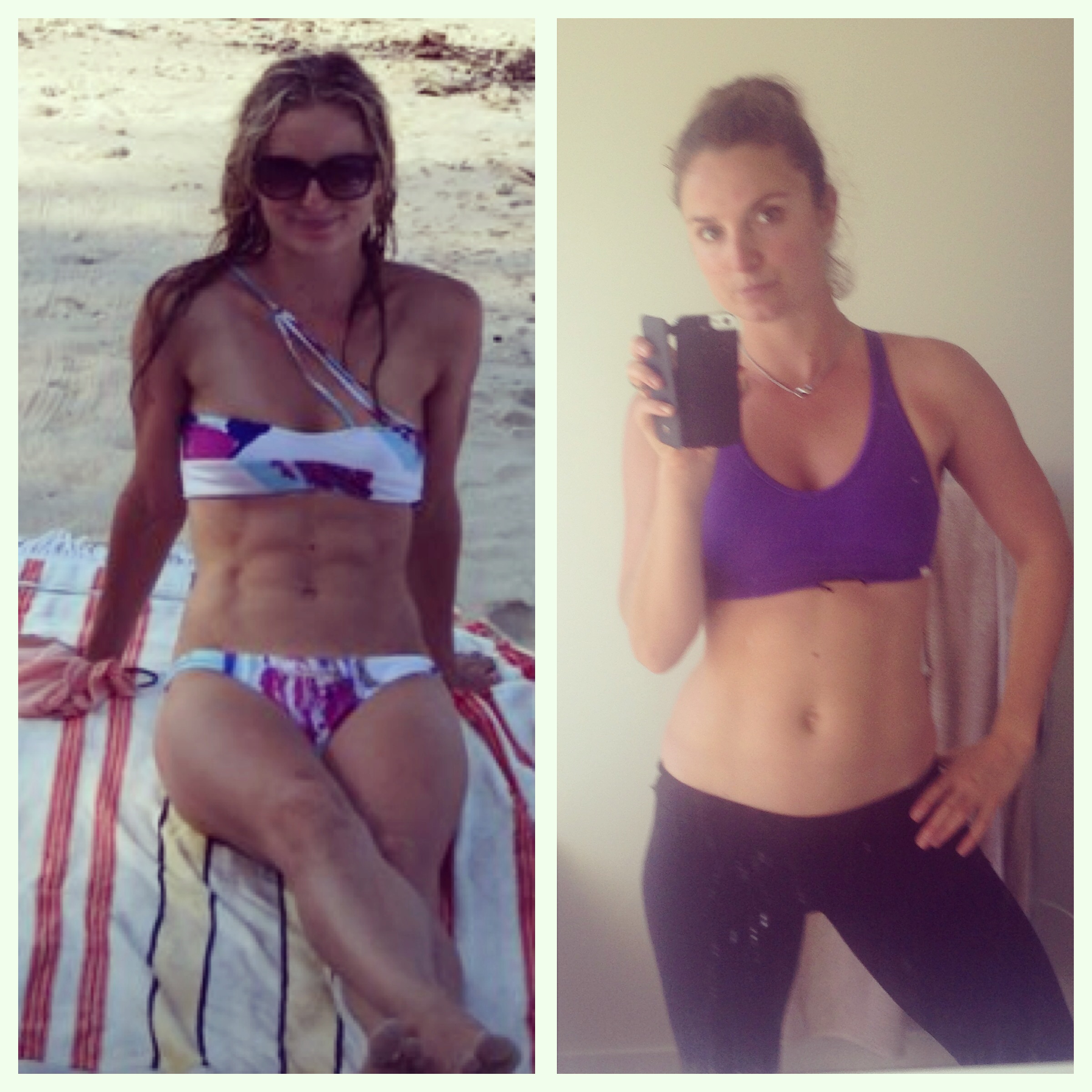
Kate: For reference purposes, here is my before and after pic to show my progress. Please excuse the hair in both pics – one was scraggly beach hair and the other sweaty post-workout hair. But it’s not about the hair (although it is thicker and more lustrous nowadays).

Kate’s journey started a year ago. I remember sitting at the I Quit Sugar kitchen table and chatting to her about it. Her lunch reflected her mission…but I’ll let her tell you more about this. In an upcoming post I’ll also share where my own (similar) journey has wound up. I’m not ready yet. Soon.

Over to Kate….

“Who knows when my body image issues started?! Until recently, I have never really considered them as “issues”.

I have always had a very athletic physique. I started competitive gymnastics at a very young age. In primary school I had shoulders wider than most boys my age. I could beat my teenage brother in a push up competition. And I had a six-pack.

Throughout high school and until now, I have always been more active than most. At times in my life I have taught up to 16 hours of group fitness each week. This is not normal. I have maintained my flat, six-pack abs throughout my life (aside from a brief 6 month beer-drinking stint in college). To some, I have the nick-name “abs”.

Before you think I’m an absolute wanker, let me get to my point. I have worked hard to get these results….at a significant cost…..

A year ago, aged 29, I was diagnosed with hypothalamic amenorrhea.

Hypothalamic amenorrhea basically means your brain stops communicating to your lady garden. Female hormone production slows and menstruation ceases. My period stopped two years ago. Some of you may be thinking this sounds

Read more

The daggy things my friends and family do to make a difference

Want to know how to get me spurting flames at a dinner party? Tell me that the small things we as everyday people do can’t make a difference to the planet. Oh, where do I start? I know: food wastage. It’s the biggest environmental concern today (and a bigger polluter than cars or industry) and the biggest contributors to food wastage are consumers. Us. Not “the government” or “someone else”. Us. Everyday people.

xxx
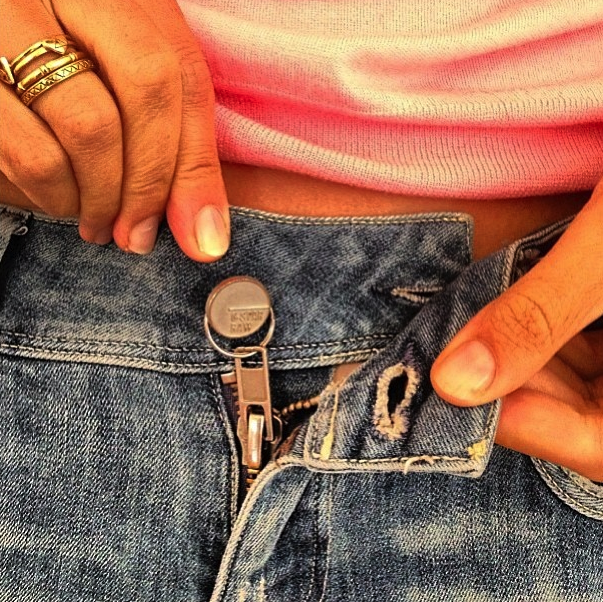
My zip fix on my seven-year-old jeans

I could go on. But I won’t get myself started. Instead I’m going to hand over the floor to my friends and family who I’ve co-opted to share their funny little ways of doing stuff that saves resources in one way or another and that add up. I’ve kicked things off with a few of my own…

I fix a broken fly with a key ring. I thread a ring from a keyring through the zip tab and then hook it over the button to keep it from falling down. I then button up as normal.

I use half the amount of laundry liquid manufacturers say you should. CSIRO did a study that found using 50 per cent of a scoop is just as effective as using a full one.

I do the same with dishwashing liquid. I use my blender for this. After making a smoothie I place a tiny drop of dish liquid in the carrier with hot water and blitz for a second or two. It produces a turbo foam that I then use to wash a load of dirty dishes.

I dry my ziplock bags on my kitchen window. I get about a dozen wears out of a ziplock bag by washing them and reusing. They’re a bugger to dry, however. But I have a trick: I smack them onto a window. They stick trans The daggy things my friends and family do to make a differenceand dry, then drop off when ready to reuse.

I have competitions with myself about how far I can stretch a meat dish. You can check out my post yesterday on this.  Sustainable Table‘s co-founder, Cassie Duncan, does the same: “I’ll cook a lamb shoulder, eat it, then make souvlakis with

Read more

How I stretch one organic chook to make 15 meals

Some people watch Game of Thrones. Some play Ultimate Frisbee. Me, I get pleasure from finding novel ways to stretch a chicken further.

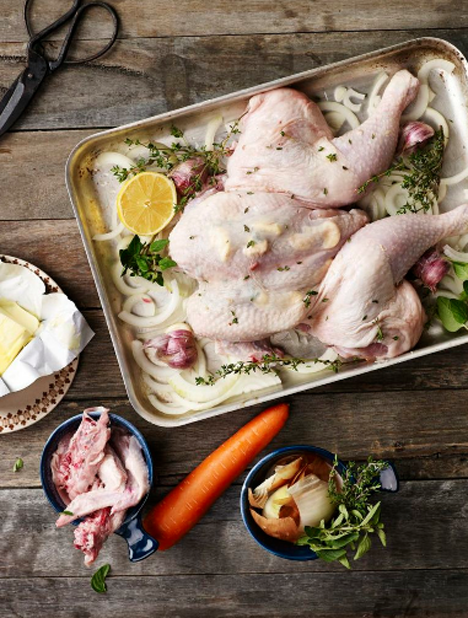
Roast Chook, ready to cook

For a whole bunch of reasons (that I outline in my book I Quit Sugar For Life), one should always try to invest in an organic chicken. You can read more on this here. These things can be expensive…but not if you take full advantage of its goodness. The greatest nutritional and economic bang for your organic buck comes from eating the meat as well as the carcass, boiled up as a stock. The bones, skin and giblets contain the life-giving minerals and electrolytes that make chicken broth so good for the soul.

I cook the whole chook, often slowly, to extract as much nutrition as possible. This works out to be very economical for you, especially if you stretch a $20 organic chook to 15 meals…

Oh, the fun you can have with a Choose-your-own-adventure challenge! To play along, it entails starting with one (bulk-cooking) dish, then dragging out the various leftovers, scraps and by-products from there.

1. Start a roast chook (recipe below). Serves four.

2. Take the leftovers to make a roast dinner gratin for the next day. Serves one.

3. Freeze the remaining portion and use it to make chicken pops at a later date. Makes four snacks.

4. The carcass from the roast is used to make Leftover Chicken Stock. Makes six serves.

Read more

A comforting note to single people. From me.

This is a thing: if you’re single in your 30s or 40s you can feel like you’ve missed a steamin’ big ship. Dominant discourse, sadly, goes like this: The pickings are slim; it’s all second rounds and baggage and receding hairlines. And it can feel helpless. Hopeless. Because you just can’t find people who fit the bill, who inspire something in your loins. Where are all the good men and women? They’ve been taken, you reason. You’ve missed the ship.

Image via Favim
Image via Favim

Whether we honestly feel this way in our more grounded moments or not, this is how our plight is often represented. But, I have another take; it goes like this…

By the time you’re in your 30s or 40s, your life is pretty ace. Most of us aim, at least, to improve our lives year by year (otherwise, what’s the point?!). And by this settled age, life is often in a pretty good spot, or, at least, better and richer than it was in our 20s: great friends, a career with up to 20 years back-end development, enough money to be able to not have to live off lentils and all-you-can-eat-Tuesday buffets, and to head to the pictures once in a while. You’re not frantically proving yourself. Perhaps you no longer work weekends. Maybe you finally feel you’re quite good at what you do. You know what hobbies make you happy. You don’t stay at parties any longer than you want to. You get the picture…

In an ideal world your partner should improve your life, not detract from it. Right? If a partner is making your life more difficult, and not not adding to your experience, then you probably shouldn’t be with them. Yeah?

So, add these together and you get this…

In your 30s and 40s, your standards for finding a partner are super elevated. Your personal bar for allowing anything or anyone into your orbit has lifted with each passing year, just as a course of nature. In my 20s it was pretty easy for someone to add to my life, because it wasn’t fully formed. When I started dating a guy at 21 we were building from a pretty low base, together. But now, my life is rich and varied and independent and fun and full. I don’t mean to sound as arrogant as I do when I say that my life now is too good

Read more

My Paleo guide to Sydney

You ask, I oblige. A lot of you have been wondering where I eat well in Sydney. So, here, a guide to how to eat like a caveman in my hometown. Hand up in the air before I start: I’d just like to say ladies and gents that I don’t classify myself as “Paleo” as such, mostly because I really don’t like to restrict my eating to a label. I eat according to what makes sense, and how my body feels. I ebb and flow. Sometimes I just can’t face dairy. Sometimes I need carbs (although, I’m selective about which ones, always opting for nutritionally rich options). Sometimes nuts hurt my guts.

"And so you want me to drink this liquid kale substance?" Shooting with @jo1foster @marijaivkovic at @porchandparlour for @iquitsugar ... One of my favourite #iqs joints!
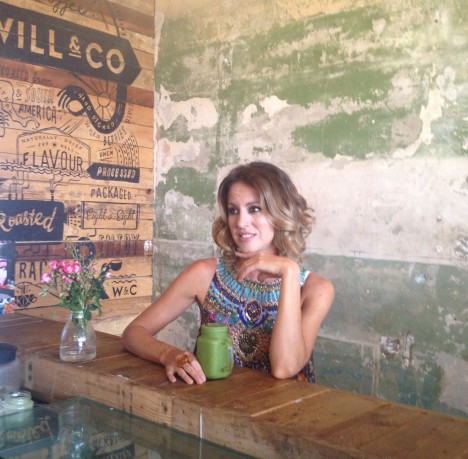
“And so you want me to drink this liquid kale substance?” Sitting at Porch and Parlour during a recent IQS photo shoot. (This is one of my favourite IQS joints!)

Yessssss… I quit sugar. But as I outline a lot, quitting sugar is mostly a really snappy way to cut out processed foods. And nooooo…I don’t eat gluten. But that’s due to my autoimmune disease.

But labels aside, I tend to find Paleo eating an easy way to navigate my way to nutritious options. I outline my thoughts on the inherent value of the Paleo diet in I Quit Sugar for Life. The approach is fundamentally low-starch, anti-processed and pro-organic. It turns to meat (pasture-fed; nose-to-tail cuts), saturated fats (no processed or seed oils) and vegetables, with a little fruit. Paleo is also anti-sugar and the philosophy overall (eating whole, living sustainably and dodging toxins and stressors) is on the same page as me and my messaging.

When I travel I find Paleo eating a particularly helpful approach to adhere to because Paleo-orientated outlets will tend to prioritize ethical meats and good quality veggies…both of which I crave when I’m on the road. Which is why I’ve written this Paleo Guide to Londonthis one for Calgary and Lake Louise and this guide on how to eat Paleo (ish) while travelling.

Anyway, shuffling on. Here’s a rundown of great places to eat in a Paleo fashion here in Sydney (grain-free, pasture-fed meat, organic vegetable etc). I got a few of my fellow cavemen and cavewomen to share their thoughts, too. Nom-nom-on!

Porch and Palour, Bondi. I rather love the Porch. They “get it” in a pretty relaxed kinda way. They cook with coconut oil, serve Suveran’s sprouted bread, offer a side of beef with breakfast and so on. I like their breakfast bowl (steamed greens, avocado, herbs and boiled egg …I ask for no quinoa) and the grain-free pea pancake (with a boiled egg

Read more

Last chance to sign up to the 8-Week Program

What will we be eating for eight weeks? Will the meals be low-calorie? Will they have enough calories? Will it be parsimonious mungbean-y rabbit food?

xxx
One of our breakfasts on the 8-Week Program. The meals below are also highlights on this round…

Sign-ups for the next round of the 8-Week Program close close at midnight, Tuesday June 3 and I know some of you on this blog are debating in your heads about whether to join, mostly – it would seem – concerned about the food. To answer in part: NO MUNG BEANS ARE USED IN THE CREATION OF THIS PROGRAM! Actually, that’s a lie. We do, in fact, do a sprouting workshop during the Program and mung beans are an option!

Click the button below to sign up today.

MONDAY1week3-copy

To answer the other concerns…

According to dietician Marieke Rodenstein, who analyses all our meals to ensure they are as densely nutritious and sound for those quitting sugar, the Program meal plans meet all dietary guidelines and, in fact, exceed them. They are densely nutritious and exceed all macro and micro nutrient recommended daily intakes. You can read what Marieke 

Read more

The problem with pre-eating

I’m not sure where I heard this term. It was in passing, a cursory phrase to describe something so familiar to us that no one – to my knowledge – has paused to discuss it in depth.

Image via Favim.com
Image via Favim.com

So many of us pre-eat, especially at dinner. Peanuts, crackers and cheese before dinner. The desserty treat when we can’t quite make it to lunchtime. We think we can’t last, we’re that hungry. Or that’s what we tell ourselves.

This is the thing I wonder:

Are we so uncomfortable with the feeling of hunger, that we have to get rid of it before we eat?

I also wonder – actually I strongly suspect – it could have a lot to do with being scared of restraint and lack. Many of us fear that feeling of missing out and the feeling of “emptiness”, for a whole quagmire of really messy reasons.

We shove food down on top of hunger, hoping it will silence all other emptiness or flutteriness we might be feeling.

There’s also this: As I’ve written before, our willpower muscle has limited strength. After being worked all day, it becomes exhausted and by 6pm it falls into lactic collapse. Which is why we tend to pre-eat at this time.

But pre-eating is also a chapter in the big book Why We’re Getting Fat. Which is the companion title to The Story of How We Lost Our Real Appetite.

* We tend to pre-eat food that’s carby. We do this to stoke our flagging blood-sugar levels. It gives us a quick kick and is a

Read more

Why I drink “natural” wines…

This is a post that is probably going to introduce many of you to a trend that is very new, and yet as old as the hills. It’s become a pet subject of mine lately. My efforts to take eating and drinking back to no-brainer basics has seen me head here. Ditto my efforts to get back to a more basic, robust, real way of life.

Image via Pinterest
Image via Pinterest

I’m hoping by the time you get to the bottom you’ll be equally intrigued. So do natural wine enthusiasts Mike Bennie, a wine journo and organiser of natural wine events, including the Sydney Rootstock festival, and Richard Harkham, Hunter Valley natural winemaker and the producer of this natural wine documentary, who I’ve co-opted to pipe in with their pithy insights along the way. OK, let’s pop a cork…

What is natural wine?

Good question, no straight-forward answer. I’d describe it as “minimally fiddled with”. Or the equivalent of using pure rosehip oil as a moisturiser (one ingredient, no fuss, no added bits), or of using a glug of olive oil and a squeeze of lemon juice as your salad dressing…get the drift?
It’s keeping things as simple as possible and as close to the ancient practice of squashing some hand-picked grapes in a vat.

Mike adds that it’s a bit of an umbrella term that can describe completely unadorned wines (quite literally hand-picked and squashed grapes) from biodynamic vineyards made with minimal intervention and put to bottle without sulphur. But it can also include wines a bit further up the fiddled-with spectrum – wines from sustainably farmed vineyards with some sulphur addition used to get wine to bottle. As a rule natural wines include most or all of the following tenets: sustainable and organic and/or biodynamic viticulture, hand-picking of grapes, no heavy machinery, low new oak usage (if at all), natural fermentation, no chemical or winemaking product additions, minimal (or no) sulphur use.

Richard sees natural wine as being like a naked body (“You can see all the blemishes”) and points out two interesting factoids:

  • 1. This vagueness as to what constitutes a natural wine causes lots of arguments within the “movement”. [Indeed, note some of the conjecture in the emerging comments below – Sarah.]
  • 2. The modern natural wine “movement” began as a backlash to the science and technology that’s led to a loss of identity and personality in wine.

Why natural wine?

There are a few things that appeal to me.

Read more

Wow! Dr Lustig, Dr Noakes and Action on Sugar all in the one room!

This is a brazen community announcement, as I figured you might be interested in this little update. The third round of my I Quit Sugar 8-Week Program is about to start and it’s bigger and better than, um, the last round (not so keen on too much hyperbole, as you all know!).

Dr Robert Lustig and I share a wine after chatting why the red stuff is good for you
Dr Robert Lustig and I share a wine at a recent conference where we were both speaking (PS a glass of red wine is ALLOWED most nights of the Program).

I won’t take up too much marketing oxygen here; you can read more about it over at I Quit Sugar. I just wanted to highlight something that I think adds to the value and bigger picture of what I’m doing.

One of the biggest reasons I developed the 8-Week Program was to be able to provide emotional and informed support for people during their sugar quittage. I just couldn’t do it via books, or via random encounters in the street. By having an online Program, and taking on extra staff (eek!!) I could set up forums where questions can be answered in an intimate yet bulk manner. The Program has gradually attracted support and endorsement from some high-profile players in the anti-sugar debate, many of whom are wanting to support what I do and help many folk in their quest to quit. They’re doing so by joining our panel of experts who answer all the niggling, nagging and emergency questions that come up as we go.

I’ll introduce them below, along with a few things I’ve learnt from each of them.

Dr Robert Lustig

Pediatric endocrinologist Dr Robert Lustig is the author of Fat Chance and, most recently, The Fat Chance Cookbook. But it was Lustig’s lecture “Sugar: The Bitter Truth”, with over four million views on YouTube, that placed him at the forefront of the sugar debate.

Lustig and I were both keynote speakers at the recent FIZZ symposium in New Zealand.

* Rob often shares that obesity isn’t the problem. Metabolic disease is and obesity is just one “symptom” of metabolic disease. This has stuck with me… and has alarmed me (obesity is only the tip of the health disaster iceberg!).

Read more

Paleo salmon chowder plus a giveaway

The interwebs continue to get tighter. As some of you know, I recently connected with Mickey Trescott from Autoimmune-Paleo.com via Instagram (I think it was) on my recent US trip. Turns out she found me years ago when she got diagnosed with hashimotos and began reading my autoimmune posts. Wonderfully, she went on to study the topic intensely and now follows a strict autoimmune protocol, thus healing herself dramatically.

Salmon Chowder xxx
Mickey’s Salmon Chowder, recipe below

Her tenacious and dedicated efforts put mine to shame (I get a bit lax with the grains, nightshades and gut-building stuff).

Anyway, when I passed through Seattle we managed to catch up for brunch and bush walk and did what hashis sufferers do best – talk passionately and excitedly about stuff…including our illness. Turns out her book was about to come out and she promised to let me loop readers here into things when it did and to share a recipe and give away a few copies. (Giveaway details below.) Here’s her chowder…totally Paleo and gut-building and autoimmune protocol perfect.

Salmon isn’t necessarily the most sustainable fish to eat (large fish generally aren’t; to see my guide on which are, go here), but when you’re using the carcass to make the stock (as you do in this recipe), you can offset things somewhat. Also, I advise asking your monger to give you the offcuts (not the cutlet or steak) – you’re cutting it up; it doesn’t need to be a perfect shape. Additionally, I advise tossing the bones and skin Mickey asks you to trim into the

Read more