a chat with Hugh Mackay about getting creative (sunday life)

This week I’m cruddily creative
tumblr_l3umwpjqrK1qzvvrno1_500

Every now and then I use the auspice of this column to meet people I’ve always wanted to sit next to on a long plane trip so as to pick their brains for fatty morsels on how to make life better. It’s not a bad perk of the job. So, on Tuesday I arranged to have afternoon tea with social researcher and ethicist Hugh Mackay.

Mackay is a man whose values and considered opinions I’ve gravitated to since I was a kid, like a little mollusk to a sturdy pylon in rough, swirling waters. He’s spent more than 50 years observing and reporting on what matters to Australians, the fatty morsels from which he’s collated in his latest bestseller “What makes us Tick“, I figure, as we order sencha, he might be able to answer this: what’s the one thing that works?

Having interviewed tens (if not hundreds) of thousands of Australians and spent decades reflecting on his own sense of wholeness, this is what he reckons makes for a better life: Being creative. And often.

We both agree that the pursuit of happiness is not much chop when it comes to determining a better life. It’s fleeting and only one emotional expression among many on the spectrum. A satisfying, full, purposeful and whole life is what we’re all after and to achieve this requires knowing ourselves, our true, “inner” selves, which is something Mackay and I both agree on, as do a long tradition of philsophers, theologians and eastern spiritual types. And the shortcut to this? Being creative.

Read more

four tricks to reduce mobile radiation

I have to share this. I was going to put it on Twitter but it’ll take too many characters.

100493_4_468

The New York Times has just run a story on all the studies that point to cells/mobiles frying the brain. The put a link to a list of the relative amounts of radiation various cellphone models emit, or their SAR (specific absorption rate). This number indicates how much radiation is absorbed by the body when using the handset at maximum power.

But more important than looking for a low-SAR phone is how you use it, they say.

So, some tricks.

1. Wait until after your call has been connected to put your phone next to your ear.

Phones emit the most radiation when they initially establish contact with the tower, making their “digital handshake.”

2. Tilt the phone away from your ear when talking and only bring it in close to your ear when you are listening.

Which always looks funny…but there’s method to the madness. The emission of radiation is “significantly less when a cellphone is receiving signals than when it is transmitting,” said experts at Rice University in Houston.

3. Be still.

Read more

are you left or right brained?

Don’t we just love to test ourselves to see “which one” we are! I think I did this test years back. Perhaps you’ve seen it? Can you see the dancer turning clockwise or anti-clockwise?

Spinning-lady-5693171

If clockwise, then you use more of the right side of the brain. And vice versa. Most see her turning anti-clockwise. Which I find IMPOSSIBLE to fathom. I can only see her going clockwise. Surprising…I’ve always convinced myself I’m completely left brained – rational, logical etc.

See the rundown of the right and left-brain functions. Apparently you can try to focus and change the direction.

Since I posted this, reader Teresa sent me a link to a site that explains how this works (and that the right/left brain divide isn’t accurate – we use both in tandem)…

What they reveal is how our brain processes visual information in order to create a visual model of the world. The visual system evolved to make certain assumptions that are almost always right (like, if something is smaller is it likely farther away). But these assumptions can be exploited to created a false visual construction, or an optical illusion.

The spinning girl is a form of the more general spinning silhouette illusion. The image is not objectively “spinning” in one direction or the other. It is a two-dimensional image that is simply shifting back and forth. But our brains did not evolve to interpret two-dimensional representations of the world but the actual three-dimensional world. So our visual processing assumes we are looking at a 3-D image and is uses clues to interpret it as such. Or, without adequate clues it may just arbitrarily decide a best fit – spinning clockwise or counterclockwise. And once this fit is chosen, the illusion is complete – we see a 3-D spinning image.

LEFT BRAIN FUNCTIONS

  • uses logic
  • detail oriented
  • facts rule

    Read more

I refuse to dumb down. you?

I saved this passage below from Daily OM ages ago. It describes those scenarios where you’re at a ra-ra gathering and you’re looking around and… everyone’s an idiot.

cloudy-photography-of-lissy-elle

Which is a judgment. But, honestly, sometimes it’s true. Like when you’re sober and everyone is pissed or on the gear. Vibes spread and it’s easy to get caught up, or dragged down, and to dumb down so you can endure and fit in.

I liked this advice:

The ability to go into any social situation and sense the level of consciousness in that situation is a gift…Sometimes, when we get into a particular social situation, we may feel pressure to play it small in order to fit in. Perhaps everyone is drinking or smoking excessively, engaging in gossipy small talk, or complaining bitterly….

One viable option is to quietly endure the situation, keeping to ourselves until it is time to leave. In this way, we take care of our own consciousness and protect our growth process.

Another option is to interact in a way that honors and pays respect to the people in the group, while gently attempting to shift the level of consciousness with our input. In order to do this, we must maintain our own vibration…Being able to stand on our own, separate from the crowd, is a powerful milestone on any spiritual path. It can be difficult in the moment, but when we arrive on the other side, our integrity intact, we may find ourselves feeling positively smart.

I’ve learned to do this. I don’t always drink when I go out; I hate drinking without food and my body doesn’t deal with being drunk any more. So I do find myself standing at parties drawing on every iota of strength to not fall over in catatonic boredom when people are frothing empty substance-fueled foam.

Read more

Atlas reconnect: the deal?

I AM the human guinea pig! Can’t help myself. I mentioned the other day I’d tried Atlas Reconnect… because the idea was planted and I figured I should test it. It’s a funny little technique – it involves a practitioner using a pen-like device that sends pulses into the soft tissues around the atlas vertebra, the top bone of the spine.

94118_2_468

This loosens things enough to allow the atlas to naturally slip back to its natural position. Natural? Apparently so. Most of us have an atlas that’s disconnected which in turn causes all kinds of ailments – crap digestion, headaches, general foginess, sleep problems, bad posture and so on – from poor blood supply getting to the right parts of our bodies.

* I did the adjustment with Sean Innis, who brought the concept into Australia and trains up other practitioners around Australia. He’s a dude.

* it takes one session only – about 45 minutes

* there’s no manipulation or cracking – just the buzzing pen thing

* it costs $200 ($100 for kids) you can find a practitioner here.

How did I find it? I emerged from the treatment pretty spacey and floaty.

Read more

be gentle with your parents

Reader Dani commented on the Rules of Life post I did a while back and pointed me to Marion Winik’s “Rules for the Unruly”.

Rule #5: be gentle with your parents.

180

A reminder of much worth, I think. Our parents need our gentleness and we need the full, whole feeling that we get when we give it to them.

Part of the reason I can be rough and impatient with mine: I find it difficult watching my parents get older…and slower. It coincides with life speeding up beyond what most of us can deal with.  For their kids, the two paces – ours and theirs – often grate. When I see my parents I have to consciously slip into third gear. Otherwise I might just self-combust as they ask me again for directions to my house. Or bicker about who’s fault it was that mum’s glasses were left in the car.

It’s also…what’s the right word…. dispiriting (?) a reminder of our mortality (?) to see our parents become the vulnerable ones. They were always the authority. They knew shit. It’s hard to swap the roles. But the passing of the baton is really significant. I’ve been able to be far more gentle with mine since I’ve picked up the baton.

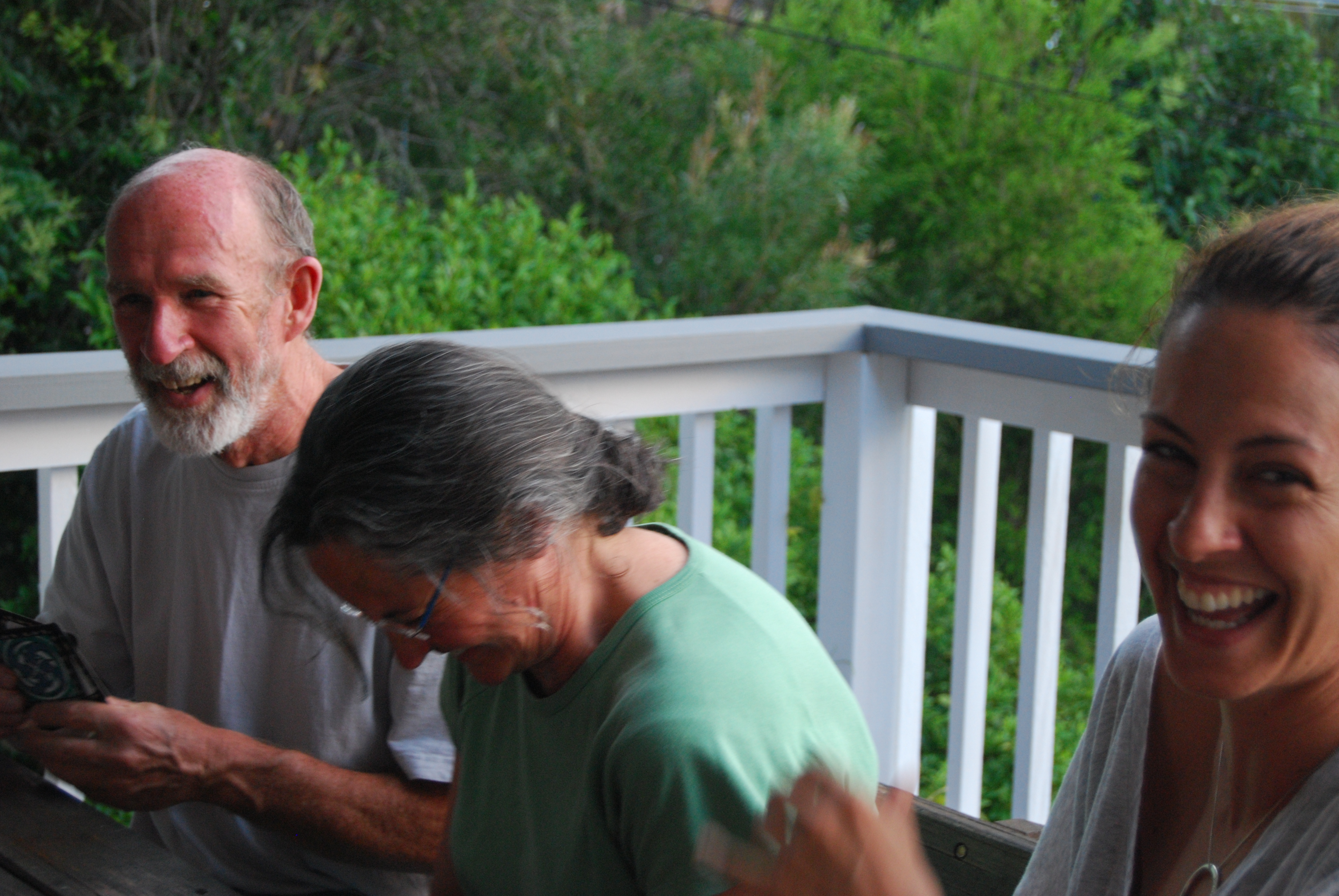
PS in the pic above Dad can’t follow the card game and does the same dumb move over and over. Or something like that.

PPS the pic below…when M and D were in their teens…D trying some dumb move on M.

Read more

how quitting sugar made me nicer: Sunday Life

This week I’m (still) quitting sugar

104201_7_468

Again, a quick note for readers of this blog who’ve been following my “I quit sugar” posts, this might seem like I’m repeating myself…I kinda did for my Sunday Life column readers. For those of you playing catch up on this topic, you can read other “I quit sugar” posts, like  my interview with David Gillespie here, the reasons why sugar makes us fat here, how I quit sugar here and some breakfast ideas here.

I quit sugar a few weeks back, to see if it made me a nicer, less cranky, agitated person, and wrote about it here in this column. I got a lot of feedback asking how I actually did it, so I thought I’d do a follow-up . I’m now able to report back from the sugar-free frontline that I’m doing OK. Many studies say it takes 21 days to overcome a habit. I’m over the hump. And the subsequent dip. And off the cranky, saccharin addicted rollercoaster for good, I reckon.

In the process, though, I’ve had to be really careful I didn’t become one of those bores who reads nutritional labels before accepting a potato crisp and who quotes guilt-inducing food factoids at dinner parties. As a colleague Nicole said, “I’d rather sit next to a funeral director than someone on a diet”. I don’t know, the last time I sat next to a dieter at a dinner I got to eat her leftover cheesy potatoes and the parson’s nose from her chicken (anyone else share my salivatory obsession with parson’s noses? No…?).

That said I couldn’t help myself and have been spurting startling “did you knows” all week. How about I share some of them with you now?

Did you know a glass of apple juice contains as much sugar as a glass of coke (about 10 teaspoons)? And did you know there’s more sugar in barbeque sauce (55 per cent sugar) than in chocolate topping?

Read more

why I’m writing a book

“Write the book that pulls you out of bed every night like a secret friend, waiting to be met.” I post this by way of follow-up from my previous post. It’s  from Australian author Louisa Deasey. Louisa – whose book Love and Other -Turns came out a few months back; I haven’t read it but … Read more

I was wondering if you could help me with my book?

I’ve been writing my book for a bit. And since a few of you have kindly asked, it’s coming along well,  in fits and spurts. I’m not sure how many of you have written something as long as a book, but GOSH IT HURTS. It drags up very challenging aspects of one’s self that one has managed to keep nicely safeguarded by routine and distractions and working for other people.

tumblr_kwt3klHbmb1qzi1p9o1_400

The biggest challenge I’m having is with my authenticity. Digging deep enough to be totally real. It’s easy to write stuff that’s clever or impressive or appealing to a particular audience that you might have conjured. Words can be wonderful cloaks.

I like this quote from J.D. Salinger about how he gets  in touch with his authenticity so he can write his best:

“It takes me at least an hour to warm up when I sit down to work…Just taking off my own disguises takes an hour or more.”

Some days it takes me most of the day. Then I have I flourish of truth at around 4pm.

But to be square with you: The book is a sort-of-memoir, sort-of-philosophical reflection, sort-of-guide-to-getting-well.  But I want the book to reflect where we’re all at. I want it to be about stuff that we all connect with and connect through. And this is where I thought you might be interested in getting involved.

Can I ask for your help? I’d really appreciate it, if you had the time.

Would you mind simply sharing any thoughts prompted by any/all/one of the following questions:

Read more