Tuesday Eats: hashed lunches

Everyone keeps asking me for lunch ideas…here you go.

I love making a hash of my lunch. Hashes are all about efficiency and sustainability and heightened flavour. For me they entail mixing up leftovers – grains, meat, beans, vegetables – from the night before and frying them with some cheese and/or an egg and tossing through some fresh herbs for zing. I also like to squeeze lemon on mine, to cut through any saturated flavours. And invariably I throw in capers. Oh, and some chia seeds! See what you think of these hashtastic ideas:
Picture 3

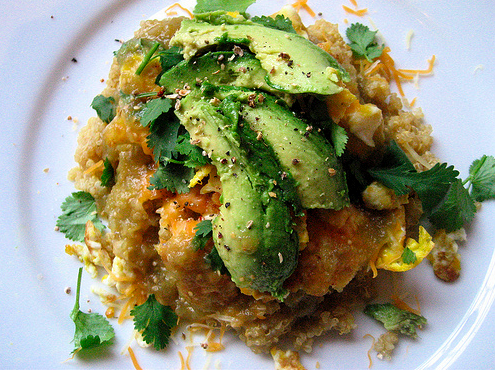
Rebecca Woolf’s “Quinuevos Ranchero”

  • Leftover quinoa (for other quinoa ideas, see here and here)
  • Eggs (two per adult, one per child. For a family of four, I cook six eggs.)
  • A spoonful of butter or olive oil
  • An avocado
  • Shredded cheese of your liking
  • Coriander (or something similarly green. Chives may just be equally delicious.)
  • Salsa
  • Seasoning of your preference

Cook your eggs as you usually do. I cook mine in a weird-wackadoo way which consists of cracking the eggs over the pan and letting them sit for a few seconds before kind of mixing the yolks and sort of pushing it around for three minutes before it’s cooked through.

Sprinkle the eggs atop the quinoa [me, I’d personally toss the quinoa through the eggs and the cheese – Sarah] then add a few pinches of shredded cheese, ASAP so it melts from the heat.

Then top with chopped coriander, avocado, salsa and seasoning for taste.
Read more

love what you love

This is a copy of a letter that Ray Bradbury (author of Fahrenheit 451, whose writing method  inspired the Pomodoro Technique…which so many of you seem to love) sent to friend Stanhope. I saw it on the Happiness Project this week. I like the oddball stationary (the figure has removed its head?). I like the … Read more

Sunday life: how to fix procrastination

This week I try self-binding

79054_1_468

Apparently, Victor Hugo wrote nude. Which is not a pretty visual.

The writer also used to instruct his butler to hide his clothes so he couldn’t head outside for a wander when he was meant to be writing. Which makes me think, if only I had a butler. This column would’ve emerged in half the time and without ingestion of the following: a packet of wasabi peas, two pots of green tea (requiring a descaling of the kettle first and four visits to the loo), three spoonfuls of cashew spread straight from the jar (requiring seperate trips to the kitchen) and, regrettably, a dozen rounds of Angrybirds.

Writers notoriously struggle with procrastination, which is why there is so much written on the topic. Dailyroutines is a site dedicated to the tortured approaches writers implement to beat the tug of manana. It chronicles a litany of rigid techniques – John Grisham used to get up at 5, at his office writing by 5.30am; Kingsley Amis wouldn’t shower or dress until he’d written a certain wad of words.

In the past few years, though, a ream (?) of academics have taken over the struggle, presumably to find a solution so they can get on with their dissertations. Professor Piers Steel, in his recent book The Procrastination Equation, says 95 per cent of people procrastinate, 20 per cent of us are chronic procrastinators and that this figure has quadrupled in 24 years, largely due to the unbounded distractions of the internet. The New Yorker recently described putting things off as “the quintessentially modern problem”. I think most of us would agree; it plagues us.

The newest research, however, has found procrastination has little to do with a lack of willpower. Which I guess is good news because that makes it sound like it’s not my fault that I’m still toggling to check my blog traffic as I write this. Steele explains when we dither it’s because our two decision making-centres – the prehistoric limbic system (which makes impulsive, delaying choices) and the neo-cortex (which can look ahead to the future consequences of doing so) are having a go-nowhere tug-of-war.

So what’s the solution if it’s not pulling your finger out and trying harder? Judging by the research I’ve been sidetracked with this week, it’s about self-binding.

Read more

how to exercise at home: a video

Last week I shared how I exercise and mentioned I’ve been going through a big shift via the work I’ve been doing with Aaron at Origin of Energy. I say it plain: it’s  boosted my energy levels and corrected my posture, two things that have suffered horribly from having an autoimmune disease. His technique is … Read more

caveman exercise: a *why and how* rundown

OK, I’ve just posted on how to exercise at home, using techniques I’ve learned from Origin of Energy’s Aaron and his team.

As a backgrounder, I’ve got Aaron to explain the philosophy behind the exercises he teaches. I love it…I’m absorbing myself in the information at the moment and meeting all kinds of people who live in this way, including a great Sydney wholistic dentist, ballet dancers, marathon runners and chefs (Martin Boetz who owns Longrain is a big fan).

  • The movement is sometimes called Paleo living or Primitive living. The Bloodtype diet is one strand. CHEK training adheres to this thinking, too. I’m not a fan of very formalised “diets” and plans like these. Aaron isn’t either. Which is why I like his approach.
  • The book or approach that many seem to recommend is Primal Body Primal Mind. You might want to check it out.
  • And for an insight into Aaron’s work with footy player Anthony Minnocello’s recovery you might like to watch this:

Aaron explains “hunter + gatherer” exercise

The human body is the expression of the earth’s wild environment. Humans are the most evolved biological organism on the planet. Our whole body is a refined tool for effective hunting and gathering.

Unfortunately most of us don’t stimulate our bodies with the movement, nutrition & lifestyles that created us. As a result many of us have become physically weak, and an expression of sedentary lifestyles.

There is is an innate reason why we find physically healthy & fit individuals attractive. They are good providers & survivors of the natural environment. So to get back your birthright of health, fitness and a lean athletic physique here are some hunting & gathering exercises:

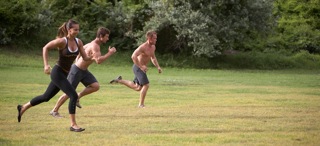
1. Interval shuttle sprints

We walked or sprinted, light jogging would have scared away what we wanted to eat. Uneven terrain & agile prey would not have let us sprint  in one direction.

So try this: 10m interval shuttle. Both feet pass the line each time with one hand touching the ground.

OriginOE_cooperPk_0028

Read more

how to get “wabi sabi” with it

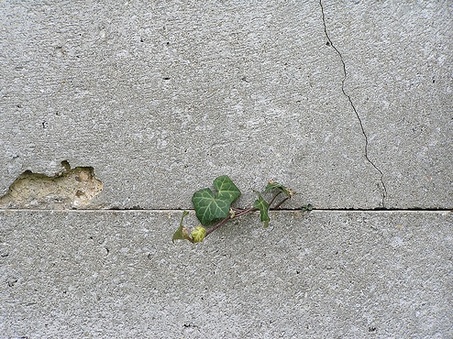
Wabi sabi is the Japanese art of finding beauty in imperfection. That statement in itself makes me happy. Observing it is a meditation and a tool for keeping life cool. And whimsicaly creative. I’m playing with it at the moment as I write. It’s proving a nifty little tool!

86462_5_468
Image by tamara lichtenstein

Wabi stems from the word wa, which refers to harmony, peace, tranquility and balance. Sabi, by itself, means “the bloom of time. Through wabi-sabi we learn to embrace our scars, rust, uneven finishes and the “bloom” of time they represent.

I found this post on eco salon about living a wabi sabi life: “Wabi-sabi is flea markets, not warehouse stores; aged wood, not Pergo; rice paper, not glass. It celebrates cracks and crevices and all the other marks that time, weather, and loving use leave behind.”

47e158243d84f

Ways to get wabi sabi with it today?

  • pick some flowers from the side of the road and play with them until you find a nicely discordant arrangment. Stick em in a jam jar.
  • take 2 or 3 old toys or heirlooms you’ve hung onto, stored in a box, and arrange them on the mantlepeice.
  • make a “still life salad”trans how to get "wabi sabi" with it

    Read more

OK, my secret weapon for quitting sugar

I’m now a month into this “I quit sugar” caper. I know many of you are doing the same and are hitting some roadblocks. So. Wrap your laughing gear around this…

One of the tricky times of the day has been early afternoon, when I want…. a TREAT. I don’t think it’s just sugar/energy thing. I think it’s a “This day is long, I need an indulgent pause to remind me that life is good” kinda thing. I used to go eat one of those small bars (35g) of dark chocolate.

cody-hamilton

Now I have a cup of this:

Miessence Berry Radical. It’s a powder made by Australian company Miessence (I’ve mentioned this company before – the most reputable organic cosmetics makers in the world). It’s a convincingly rich hot chocolate substitute, with no sugar. Actually, it’s no substitute. It’s the real deal. I add a teaspoon of the stuff to hot water with a splash of full-cream milk and it’s the most zingy, satisfying thing ever. I’ve added it to a pot of chai herbs and spices, too. Miessence recommend making it with coconut milk!

Read more

people are funny (some diptychs)

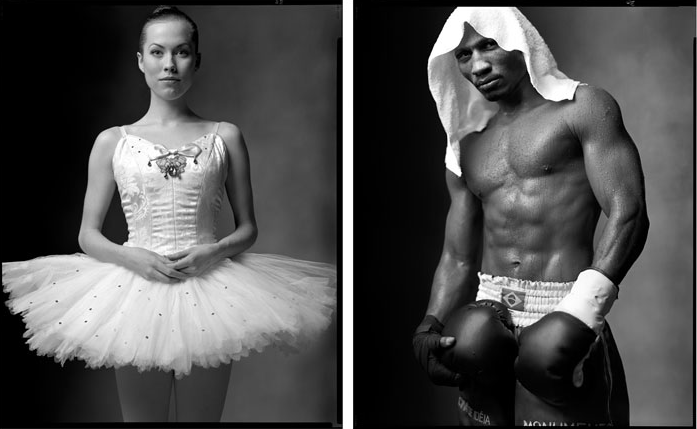
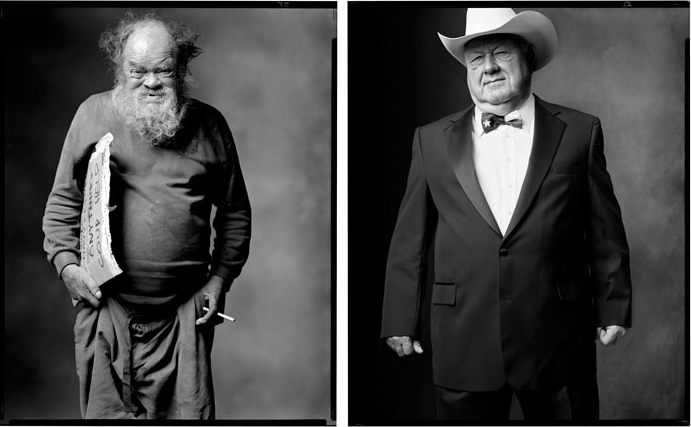
One of my favourite words is diptychs. So it happens I stumbled upon a few by photographer Mark Laita from his book Created Equal,  thanks to Brain Pickings. We humans do the same kooky things. We all want to belong, make a stamp, stand over and above each other. We want to be the “us”, to the “them”.
We pomp and perform and trick ourselves up. But under it all, even under the separatist thinking, we are the same. I find this comforting. Joyful. We’re funny little things, don’t you think?

createdequal3 people are funny (some diptychs)Ballerina / Boxer
createdequal9 people are funny (some diptychs)Homeless Man / Real Estate Developer

Read more

Sunday life: I quit sugar

This week I quit sugar (part 1)

* Dear reader, most of you have read my “I quit sugar” posts over the past few weeks and are probably wondering ‘why’s she going over this again’? Well, this should give you an insight into the turn-around times in publishing. I wrote this Sunday Life column at the same time as my first post. It just takes this long for it to be subbed, fact-checked, laid out, printed and distributed. It’s a nice little refresher for those of you who’ve been following things on this blog…If you’re new to this blog, you can catch up on other “I quit sugar” posts my interview with David Gillespie is here, the reasons why sugar makes us fat here, how I quit sugar here and some breakfast ideas here.

tumblr_l1c301xhFi1qa2929o1_500

It’s not that I’m a sugar junkie. I’m just wedded to the stuff in a tortured, forever-self-moderating way. As a kid, growing up in a drought-ravaged backwater as part of a social experiment in subsistence living (which largely consisted of skirting the breadline and tending goats), we didn’t eat much sugar. Sometimes, though, Dad, in a scene reminiscent of Charlie Bucket with his gold-foiled slither of chocolate, would bring home a Chokito bar and split it between us. Invariably we’d wind up spinning the ceiling.  And so it was I got a highly attached taste for the stuff and its maximum (!) fun times (!) effects.

As I say, I don’t eat a lot of sugar. But it’s a struggle not to. I do seductive things like convince myself that a slug of honey on yoghurt every night is wholesomely Nigella Lawson-ish – annoyingly cloying, but not harmful per se. But the trouble is, if I get even a wafer-thin taste of sugar, something wild and wooly comes over me and I have to eat the whole damn upside-down almond meal and pineapple loaf. Sugar does that; it makes us demented and we turn into Mirandas, as one friend said. Remember that Sex and The City scene when she dumps a cake in the bin, then douses it in water so she won’t keep eating it?

I’ve avoided quitting sugar for ages. Mostly because I’ve known it means never touching it again. One French study found it’s more addictive than cocaine. And must be treated as such. But lately it’s made me crankier, puffier, foggier, sicker and more attached than normal. I’ve reached saturation point; it’s time to become a nice person again.

But why quit, you might ask? Sugar’s natural. Well, yes. But so is petroleum. And surely you don’t mean fruit and honey? Yes, yes, I do.

Read more