Surely you can’t drink any alcohol when you quit sugar! It’s chockers full of the white stuff, right?! I have some good news for you – you absolutely can still enjoy a glass of wine at dinner. Or even a beer on the weekend. Because quitting sugar doesn’t mean quitting the things you enjoy! The … Read more
I hope this doesn’t inconvenience anyone, or perhaps I’m kidding myself to think it would.
I won’t be posting for a while. My computer has died, I lost my phone, and my anxiety levels have peaked. And I’m having my first real holiday in seven years (in which I don’t have to finish a book, write extra recipes, do a photo shoot in Copenhagen…).
To be honest, I think the above first world annoyances have all happened so as to put me in my current predicament. Which is to say they’ve forced me to shut down. It is not the first time that the universe has done a “deus ex machina” job on me. You might be like me. It takes a nudge then a tap then a
I read about a new site recently – Buy Me Once. It curates gear that’s high quality and you only have to buy once, in your life. Stellar stuff. Not-so-funnily, I’m writing this sitting in a London Wholefoods. The place is festooned with “eco” messaging. And yet everything comes on disposable plates, with disposable forks and cups. In the past 50 years, we’ve come to seriously regard disposable as cool. It’s honestly insane.
I carry my slow cooker to friends’ houses for dinner – meal prepped and ready to go!
But there are murmurings of a push-back. In France the government is fighting disposable business practice in the appliances industry, part of a larger movement against planned obsolescence across the European Union. And a bunch of fashion brands are stepping up in clever ways.
This is part of my own #Simplicious manifesto. Sure, you have to buy things. But don’t buy disposable stuff. And buy it mindfully. Stuff that lasts is generally premium, which – added bonus – makes you think deeply about whether you really need it. Because, end of day, I advocate going without, wherever possible.
Anyway I reached out to Tara and then arranged to meet with her…we were both going to be in London at the same time, miraculously. It was all a beautiful thing. Then we decided to compile a list of our favourite Buy Once stuff.
Tara: A LE CREUSET POT
This is the brand that started it all and inspired me to begin BuyMeOnce. Le Creusetis an heirloom cooking pot that oozes quality and longevity. It comes with a lifetime guarantee and I can just see myself passing it down to my imaginary grandchildren. I want everything in my life to give me this feeling.
Me: Scanlan and Theodore wool and silk
I shop for fashion rarely, about once every six months. For 15 years I’ve invested in pieces by this Australian brand. They’re a premium product, but I have red silk pants that have lasted seven years (I even hand wash them) and a
And these stories need to be told, but what about the positive ones? Which clothes can you buy and feel good about? For this post, Clare Press, author of ethical fashion book Wardrobe Crisis asked a bunch of her friends (and her husband) to climb into the most sustainably produced outfits they own to help the conversation firing along. You can read her last post here where she shares some tricks for dressing with a conscience.
Clare Press: Organic cotton and Nobody
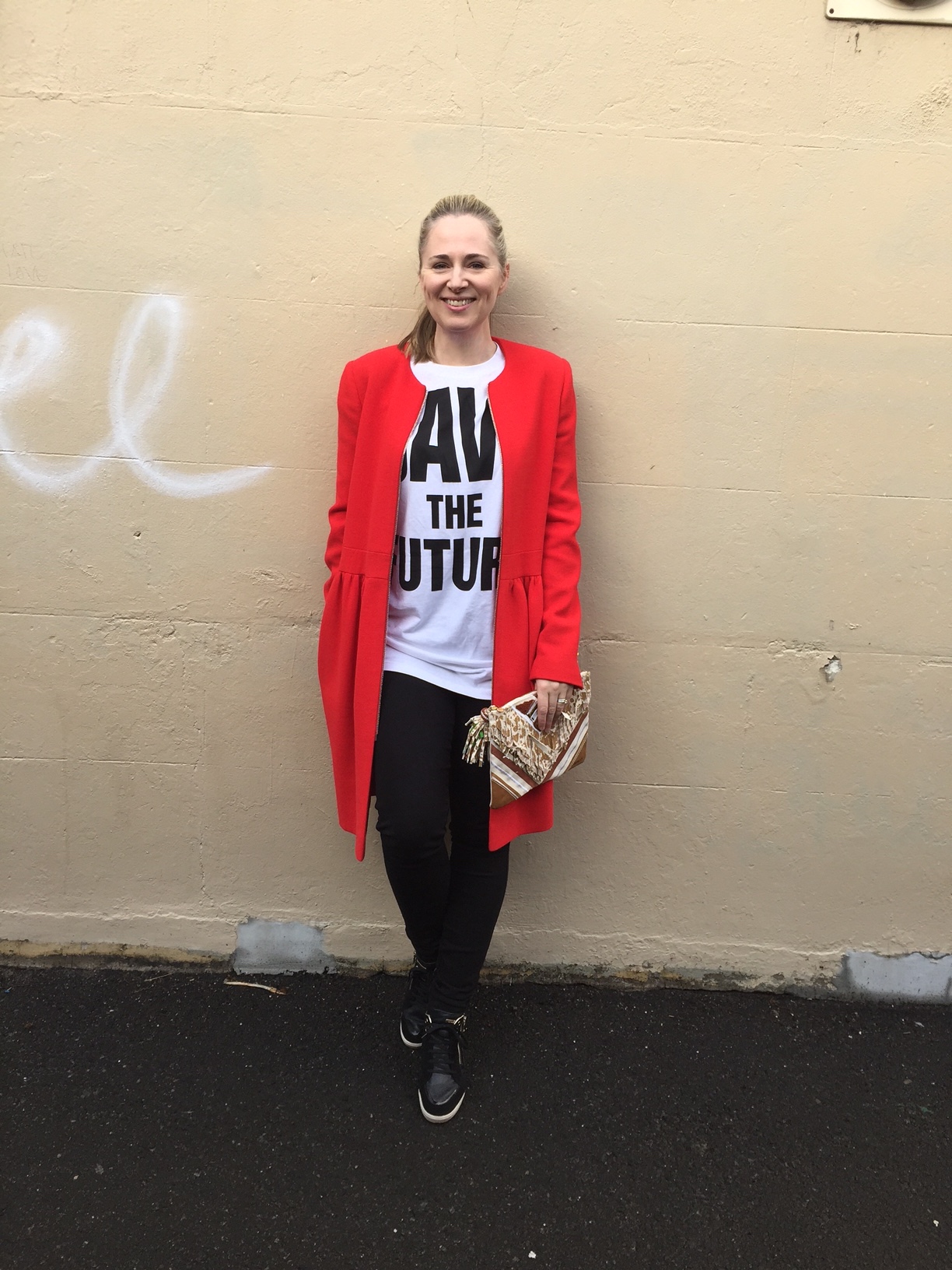
“This is outfit pretty representative of my score card – not perfect but making an effort. My sneakers are a fail, I bought them because they were comfy and have no idea how they were made. But I’m wearing my organic cotton Katharine Hamnett T-shirt, which I love because it’s sustainably produced and also very shouty: SAVE THE FUTURE! My jeans are by Melbourne brand Nobody, which is Ethical Clothing Australia endorsed. The bag is Mimco made in Kenya by Maasai artisans with the UN’s Ethical Fashion Initiative. The coat is wool, made in the UK, by Preen. They don’t identify as a sustainable fashion brand but they do make domestically and say that,
The opening line to Graham Greene’s The End of the Affair is thus:
So Graham Greene. I love his pared-back writing. He plonks the squirmy bits about life and relationships on the page via characters who are invariably flawed in quite banal ways. I find he treats his characters like Agatha Christie does a plot, inviting the read to keep going, and going even though you know the twist.
Anyway, to the quote above. It’s a comforting truth.
Comforting? Yes, if you’ve had pain (big pain), there is solace in knowing that your suffering has a point. Always. Much of the despair we feel during tough times derives from a sense we shouldn’t be feeling so despairing. And so the angst is fueled. To know that our suffering uncovers aspects of ourselves – of our heart no less – turns down the
Do you blog or write and share to the masses (however intimate or wide) and wonder why you do it? I’ve written professionally for 20 years, sharing intimate opinions and ideas across 11 columns, and I’ve blogged for seven years.
Paris, 1946
I blog here for free. I’ve written roughly three posts a week and also ran my I Quit Sugar 8-Week Program for two years without pecuniary recompense.
I’ve stopped often and asked myself why I do it. Most writers do, even when they’re paid handsomely. Because, on balance, we mostly give more than we get back. If you weigh up the blood and sweat and tears lost (priceless!).
I spoke to poet David Whyte about this when we met during his Australian tour. I asked if he felt a responsibility to write. He has a supremely special knack for going down close to the soul of us all and emerging with words that say it as we know it and need it expressed for us. It’s painful for him. I can tell.
He replies: “Absolutely, a responsibility”.
Then Jo, who I’ve turned on to Whyte, sent this to me. Sensing a waft of despair come over me as to What The Hell
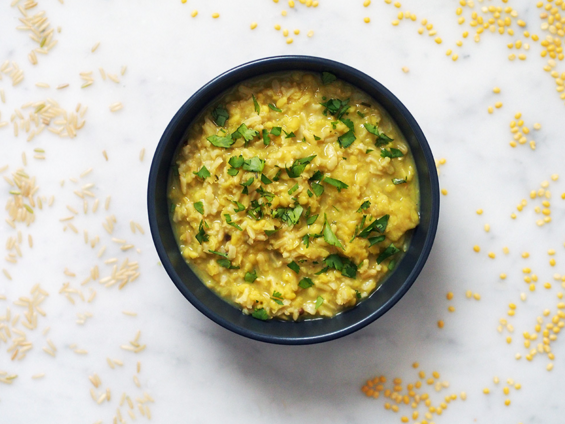
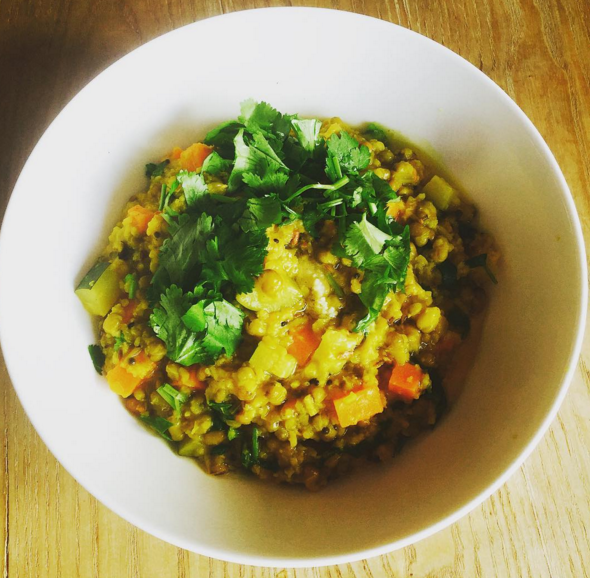
First, what is this kitcheri (pronounced kich-ah-ree) stuff I speak of rather often. (I have a recipe for Nourishing Kitcheri in I Quit Sugar For Life and an Inside-Out Sprouted Kitcheri Loaf in Simplicious; I also shared how I ate it at the Indian retreat I did some time back.)
My kitcheri combo: a vehicle for a generous dollop of ghee, lots of fresh tumeric and coriander.
In Ayurveda this mung and rice curried bowl of sweet, soft, soupy goodness is considered the ultimate digestion-healing and detox food. It’s warming, soft, light and designed to fire up your digestive energy, or “agni”, via a bunch of select spices. Indeed, it’s served in clinics when people are sick and is used for cleansing purposes (where you eat it breakfast, lunch and dinner).
But it’s a whole lotta grains and legumes!
I know, I know. The stuff is made from mung daal and basmati rice.
At first, I was dubious. I bloat up from such foods normally and tend to avoid them. But consumed in this combo, with the spices and ghee that’s added, something mysterious happens and I’ve found that when I do eat it, my digestion is pacified. Almost immediately.
I asked Ayurvedic consultant Nadia Marshall to explain the deal from an Ayurvedic perspective:
“Both mung daal and basmati rice are light in quality with a predominantly sweet taste (mung is also astringent), a cooling digestive effect and a sweet post-digestive effect. It is quite rare to have foods that are sweet/cooling/sweet… but also light. As a result, mung daal and basmati rice have the special quality of being nourishing for the tissues and immune system but also light and easy to digest. Mung and basmati’s sweet quality (both as their taste and post-digestive effect) has a calming, grounding effect on the mind/body but is also
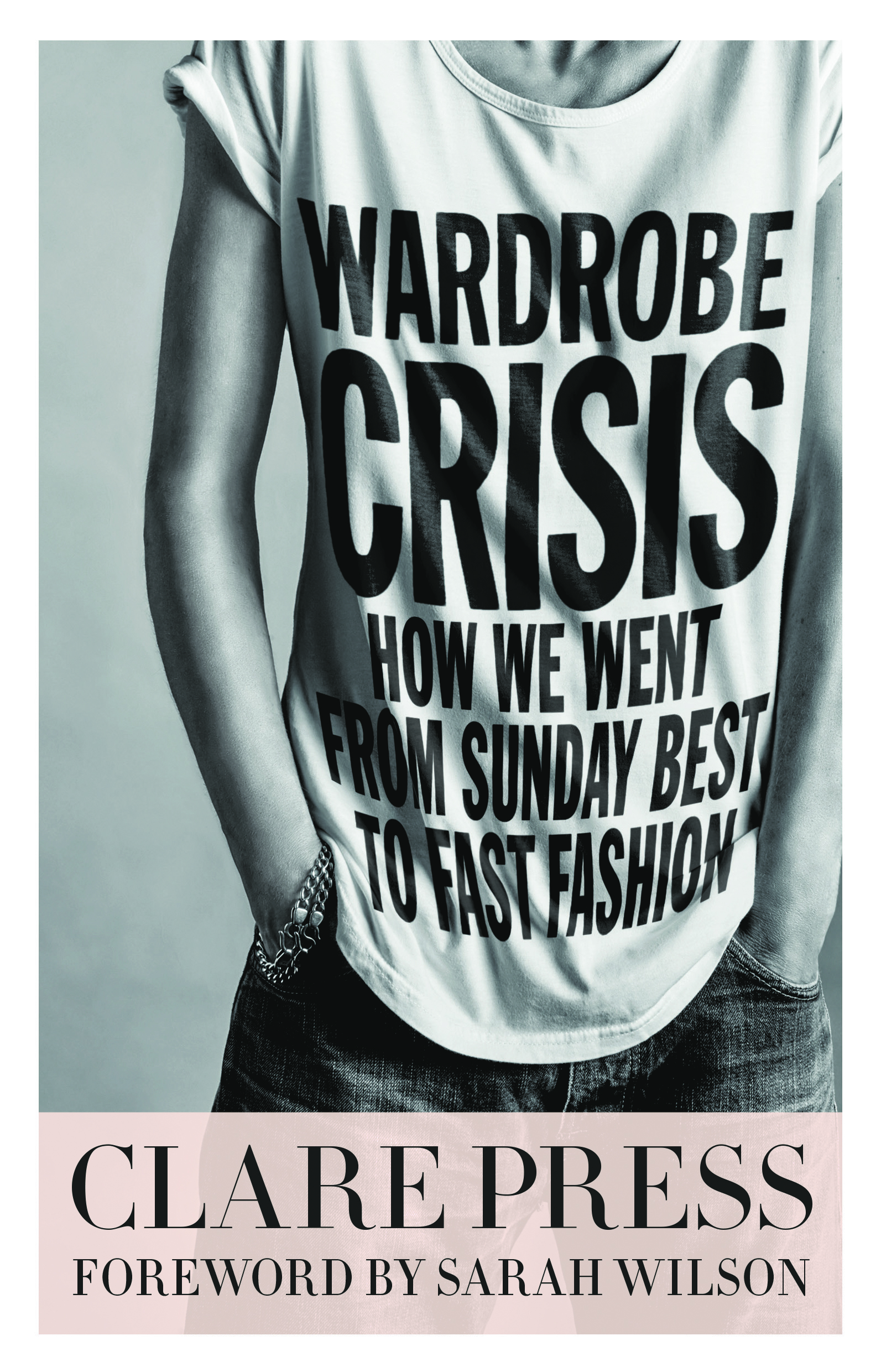
My lovely friend Clare Press, Marie Claire Australia’s fashion editor-at-large, has written a book called Wardrobe Crisis. It’s about ethical fashion, which, Clare says we often treat as an oxymoron, like “diet butter” or “paid volunteer”.
The cover of Clare’s book: Wardrobe Crisis
Clare raises stuff we need to know, like: conventional cotton farming accounts for 25 per cent of the world’s pesticides use, leather tanneries in unregulated countries pump out wastewater full of heavy metals, the dyeing of denim turns rivers blue, and it’s not unusual for factories to incinerate excess fabric or garments that are surplus to sales.
I loved the concept (of a book on all this). I wrote the forward. Then asked Clare if she could share her favourite tips for being sustainably fashionable.
Over to you Presso…
A recent survey found that American women regularly wear just 10 per cent of the clothes they own, yet when confronted by a crazy mess in their wardrobes, more than 60 per cent suspect the answer is to buy more. I’m sure it’s a similar story for Aussie women.
Here’s a revolutionary idea: how about we stop buying clothes on a whim, and start buying them thoughtfully,
First, your affliction has a name. Which is always comforting. Some psychologists call it misophonia, which means fear of sound. Which doesn’t quite capture it.
She gets it. The rage-inducing irritation.
I know because I have this misophonia business going on in my noggin big time. It’s not a fear of sound. It’s a rage-inducing irritation.
These are the sounds that get to me: chewing, especially the way people do it in (particularly New York-based) movies where they smack lips and teeth together while talking and waving a salad fork; foot tapping and leg jigging; sniffing; heavy breathing; nose whistling and vibrating mechanical devices (pool filters, air conditioning and so on).
On the sniffing thing, what is it with people aged approximately 23-43 and this thing for sniffing as they make important points. It seems to have emerged as a thing…noticed same?
Also, according to a study by Northwestern University, an inability to filter “irrelevant” sensory information is