Think men are useless? Don’t. It only hurts us.

Justified or not, women can tend to find men frustratingly lazy/self-serving/myopic/unable to plan the kids’ birthday party. And they can tend to voice such frustration often.

Image via Sincerely Kinsey

I have a friend who shrugs her shoulders and says, regularly, “Look, women are just the more capable half of the race”.

I’ve always felt uncomfortable around this kind of talk. I truly don’t know what to make about where we – the two halves of the race – sit right now. We’re confused about roles. Women feel overworked and underpaid, lumped with too much responsibility. Men feel under-appreciated, misunderstood and emasculated.

But, I don’t reckon bitching about it is good. Moaning and bitching doesn’t feel like the evolved and constructive way to go about shifting things for the better. If anything it’s always seemed resigned and passive and unhelpful. And not kind.

I echo the thoughts of Irin Carmon in this op-ed on What Women Really Think of Men in The New York Times, responding to the “men are useless” cry:

“As a feminist, I disagree. It does women, and society, no favors to grouse about female superiority as a way to let men off the hook. When society writes off men as irredeemable, we all lose.”

There’s another (essentialist) argument to be made here. Anyone mindfully engaged in pondering contemporary gender relations (ie feminists) and who might think their critical thinking is reasonably advanced has a responsibility to carry the debate to higher territory.
Read more

Interrupt anxiety with gratitude

I caught up with Danielle LaPorte the other day. I wanted to ask her a bit about anxiety. She gets it. She writes about it.

screen-shot-2017-01-11-at-9-48-22-am

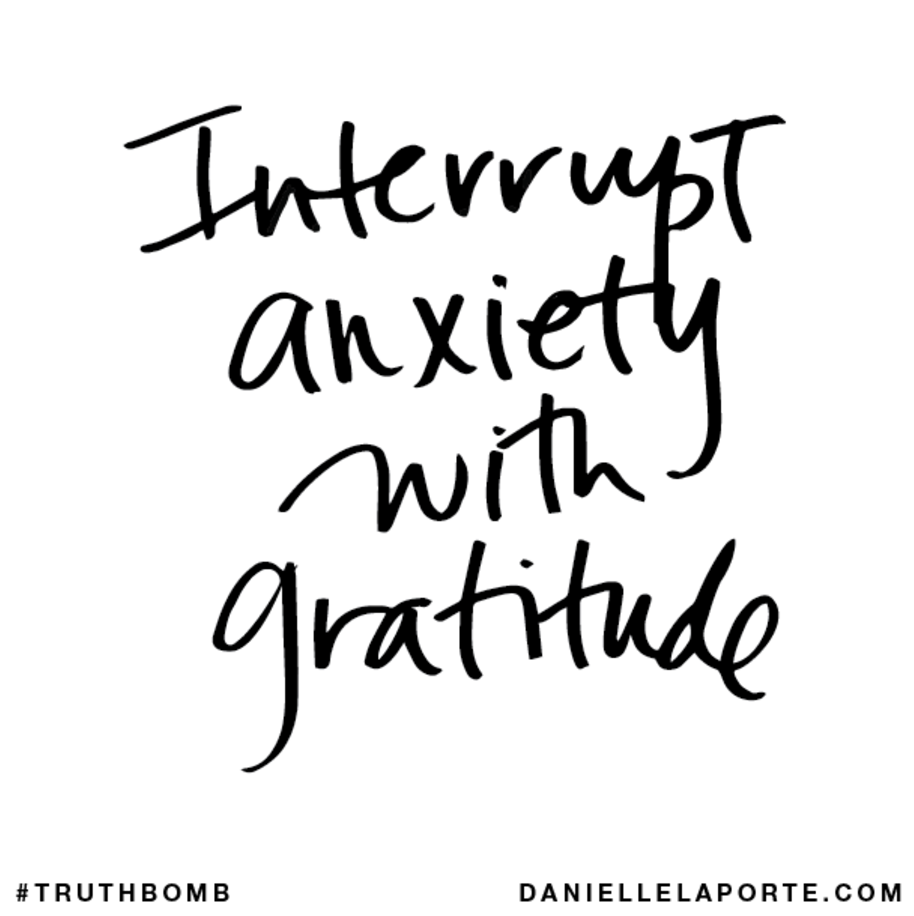
I’ve followed her White Hot Truths for a while. And her career in the self-help-of-the-brutal-variety realm. (Note: Danielle tours Australia next month, with special guest Clare Bowditch. Details, and a ticket giveaway, below). A while back she dropped one of her “truth bombs”:

Interrupt anxiety with gratitude

I like this. I’ve dug around on the topic of late. Alex Korb writes in The Grateful Brain, ‘Gratitude can have such a powerful impact on your life because it engages your brain in a virtuous cycle. Your brain only has so much power to focus its attention. It cannot easily focus on both positive and negative stimuli.’ Literally, you can’t be grateful and anxious at the same time. You can, thus, derail your anxiety by being grateful. Chuck a bomb under it!

On top of this, research shows gratitude stimulates the hypothalamus, a part of the brain that regulates anxiety.

Korb adds that the brain loves to fall for the confirmation bias – it looks for things that prove what it already believes to be true. ‘So once you start seeing things to be grateful for, your brain starts looking for more things to be grateful for.’

And thusly interrupting anxiety even more.

I asked Danielle a little more about her anxious thinking.

Me: Why do we get anxious?

DLP: Because every time anxiety shows up, it’s our psyche’s way of saying, “Knock knock, I’ve got something to show you about yourself that you really should see.”

Me: How do you cope with it?

Read more

Always telling people to quit sugar? Now you can get paid for it…

Hey, you’re probably one of those people who tells their mates and family about the I Quit Sugar 8-Week Program rather a lot. Maybe you’re a personal trainer or nutritionist and recommend it to your clients? And perhaps you’ve thought, “I should be getting commission for this!”. We’ve thought the same and my crew over … Read more

Here’s the beauty products I pack when I travel…

This year I’ve travelled a lot. And, in fact, for the past three years I’ve lived mostly in transit. And so my “beauty regime” in general is a simple and mobile affair.

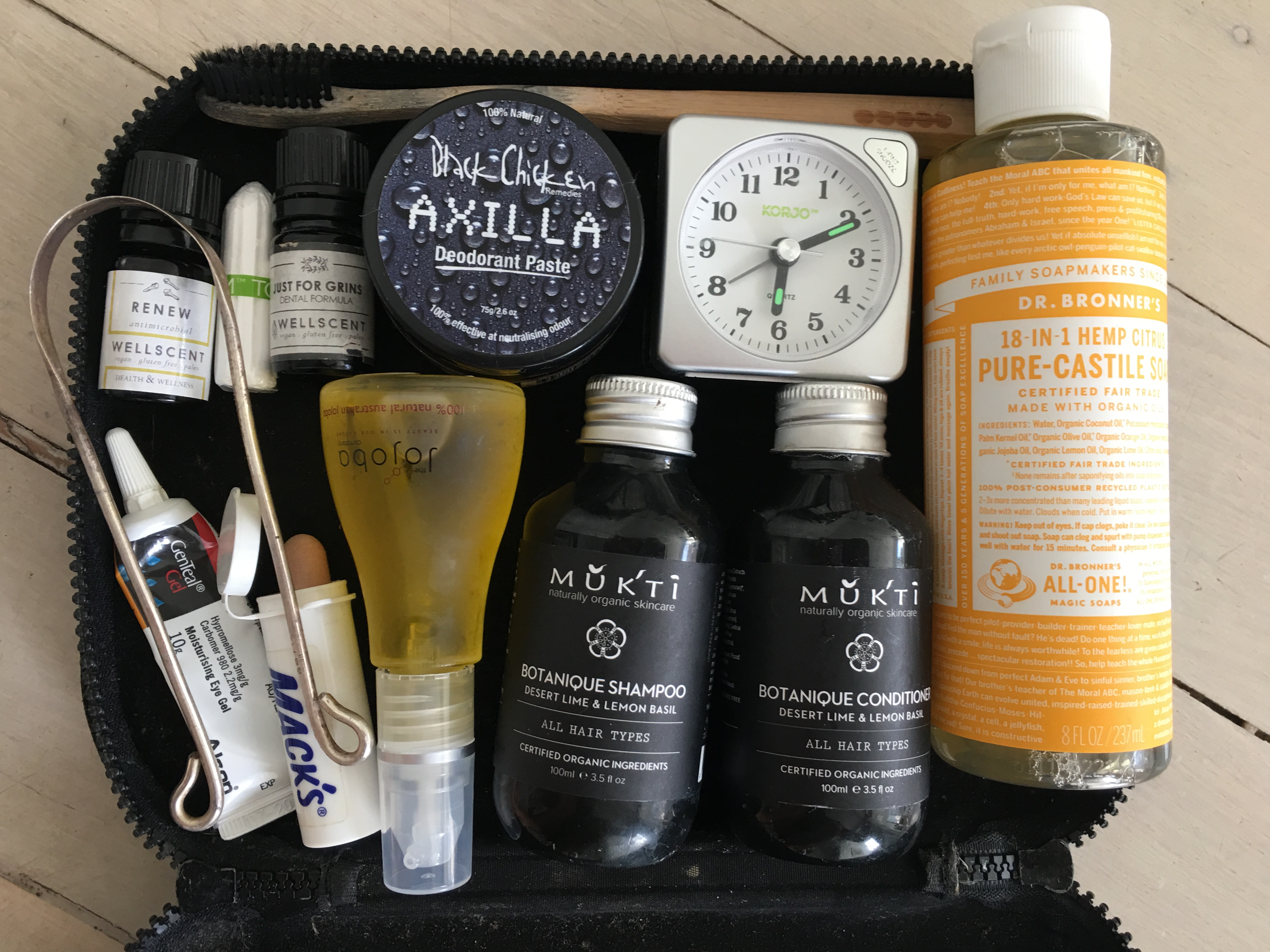
My travel case
My travel case. This is everything I use, daily. All of it. Even when not travelling.

A big bunch of you ask me via the socials to share what such a regime looks like and today I’m obliging.

Previously when I’ve done beauty posts The Folk Who Make The Products That I Use have reached out to offer a discount to you guys. I figured I’d do this again, in time for Christmas. Please be aware, however, that the recommendations are genuine – I purchased all products myself and sought discounts for you later. Cool?

PS catch up on my advertising and sponsorship policy.

How I pack my travel beauty kit

I travel very light and this has informed how I “do” beauty in general (since I live light anyway).

  • As a general rule, I work with beauty products with the least number of ingredients, preferably just the one.
  • I don’t fall for “organic” or “natural” labelling. “Organic” can mean only a few of the ingredients were grown and produced organically, not all. You can learn more about this here.
  • You can also learn about what to look out for in beauty products. And how to chose a toxin-free sunscreen.
  • I work with concentrated products – extra strong formulas only requiring small amounts, thus requiring small packaging.
  • I work with stuff that’s multi-purposeful – jojoba oil for cleansing, moisturising, facial scrub and hair control, for instance.
  • I transfer bulk stuff (eg shampoo) into travel bottles that I reuse (I avoid buying travel-size bottles as such…because it’s not a great use of packaging).
  • Everything in my kit can go carry-on (ie is under 100ml), as this is how I often travel.
  • I don’t carry body moisturiser…If things get dry, I use some olive or coconut oil from Air BnB kitchens, etc. At home, I do the same (with my own).
  • As an aside, I use a travel alarm clock. This one above is my second in 21 years. They last a looooong time. I NEVER sleep with my mobile near me.

Read more

How is the state of your heart, in this breath?

I ask, “How are you?”. 

“Busy”. “Flat out”. “So much going on.” That’s what I get back. 

Photography by Martin Tremblay

We might be busy. But busy is a choice of mindset, if you think about it.

It’s funny, busy-ness is what creates our aching need for more self-care and a deep desire to live a life we actually want. And yet, it’s also the the thing that prevents us from having this life.

Or put simply: we are too busy to live. Which is just craziness!

There’s also this. When I ask how you are, I’m not asking if you’re busy or not. The satiating, more connecting answer is a true description of where you are at, behind the busyness. The real you that’s always there, regardless of how much activity you’ve chosen to sign up for.

I read that Arabic for “How are you?” is Kayf haal-ik? In Persian it’s Haal-e shomaa chetoreh? 

Which translates as,

“How is the state of your heart, in this breath?”

Read more

Do we need a 30-hour work week? Let’s talk about it seriously.

How about this for an idea? A mandated 30-hour work week? Recently in The Guardian leading UK social policy voice Anna Coote presented the idea as something that makes sense from many angles – social, environmental and economic.

Image via Design You Trust

And yet we resist the idea. What are we all waiting for?

Technology and automation was meant to see us work less. So why are we working more? Why aren’t we making the call and pulling back from being so ‘busy’?

Me, I think it’s because we’re all waiting for someone to tell us we can. I’ve talked about the importance of creating our own boundaries many times before – we can’t wait for someone to lay out the red carpet for us. The world doesn’t work like this anymore.

But I do wonder if it’s time this critical matter (for our ‘busy-ness is making us sad and sick) might need to be mandated. If ‘someone else’ needs to step in in this instance.

Read more

Leonard Cohen: The yearning at your core

Leonard Cohen is a man who lived with inner anguish, but did so gallantly. He celebrated the melancholy of life. He planted the truth of our existence (we die, my friends!) before us without apology. He wrestled with all this, but, again, without apology.

Image via Sanjeev Kugan

In the wake of his recent passing, you might like to catch up on how he took five years (unapologetically) to write Hallelujah

And to revisit his beautiful line about how we have to become the ocean to avoid being seasick

The New Yorker published a heart-soaring longread about Cohen and his brave confrontation of darkness recently. I liked lots in it. But this bit stuck with me:

 “Even before he had much of an audience, he had a distinct idea of the audience he wanted. In a letter to his publisher, he said…

“He wanted to reach ‘inner-directed adolescents, lovers in all degrees of anguish, disappointed Platonists, pornography-peepers, hair-handed monks and Popists’.”

The line is perfectly evocative. All six cohorts share the same desperate, grasping and well-meaning pain. All search for love and come up with… death. 

Read more

My favourite longreads (for your weekend-reading pleasure)

Earlier in the week I shared how I longread. I flagged why it is such an important practice for our frazzled brains.

Today, I give you my list of favourite sources for finding long things to read that enrich my mind, make my heart soar, enhance my understanding of the world, while also drawing me in nice and close and focused and away from our terribly toggling world.

Image via polyvore.com

By way of a nice launchpad, my mate Katharine Viner, Editor-in-Chief of the the Guardian worldwide, wrote about the value of considered writing for keeping us true to truth in an incredibly rewarding longread a few months back (click on the hyperlink a few words back!), just before we met up in London during my last trip. So we chatted about the notion robustly, particularly in relation to the future of good journalism (pivotal to longreads). I quote Kath:

“My belief is that what distinguishes good journalism from poor journalism is labour: the journalism that people value the most is that for which they can tell someone has put in a lot of work – where they can feel the effort that has been expended on their behalf, over tasks big or small, important or entertaining. It is the reverse of so-called “churnalism”, the endless recycling of other people’s stories for clicks.”

I, too, believe that this is part of the importance of longreading to the human psyche. We relish demonstrations of effort expended. It reminds us we’re here for a reason. It rallies us to be more than our deadline.

Anyway,

A list of my longreads:

The Scientific American. I subscribe to their newsletter and buy digital copies of select issues. Many of their articles are free through their newsletter, however. This one on how we make sense of time was a recent favourite.

The Guardian. I follow their various sections on Facebook. I follow their Long Read section on Twitter at @gdnlongread, and their weekly email here.

Read more

This is how I do my longreads

Much of where we are feeling we’re going wrong lies in the speed at which we are moving, talking, toggling and…reading. I’ve shared one of my favourite takes on this, by David Malouf writing in the Quarterly Essay not so long ago.

Image via teachingliteracy.tumblr.com

Malouf suggests:

We are moving at a speed that’s not conducive to discerning thought.

We can’t keep up. We’re frazzled. We’re missing out on good, deep, mindful learnings. I agree and love Malouf’s way of presenting this idea.

Do you, like me, find it hard to longread? Which is to say, do you find it hard to read long, mindful articles that have been crafted carefully and go in deep, thus requiring more words and focus than a clickbait-y grab? Yes?

I’ve realised the importance of ensuring I do in fact longread on a regular basis. In part to train my brain into more discerning thinking.

This is how I do my longreads:

* I subscribe to and follow various channels specialising in considered reads on social media and via newsletter.

* I save them. I do this in a rudimentary way. I email them to myself (from Facebook or Twitter or email newsletter) and keep in a mail folder.

* I set aside time once a week to read. For a good hour or two. I make a big pot of tea. It’s a lovely ritual. 

Read more

To be a full person, you have to let nothing happen

There was a lovely response to my I have my freedom today because nothing really happened post a few weeks back. Nicely, this pierced my radar – an interview comedian Louis C.K. did on Late Night with Conan O’Brien.

Image via kailamaee.tumblr.com

He discusses the same theme. Of being OK with nothing happening. He refers to our smartphone habit – how we grab for it when we’re anxious, sad, unsettled. 

“You need to build an ability to just be yourself and not be doing something. That’s what the phones are taking away, is the ability to just sit there. That’s being a person. 

Because underneath everything in your life there is that thing, that empty — forever empty. That knowledge that it’s all for nothing and that you’re alone. It’s down there.”

Bloody hell, yeah. My God, we’re losing our bravery don’t you think? The empty forever is there. We are all alone. And we die. 

We don’t wish to have mindful conversations about this fear that we run from. We just want to keep toggling and distracting and hoping that we can connect and find worth in an Instagram notification or a Facebook reply or a Tinder swipe-right. 

Read more