don’t work nervously

I am a little obsessed by the work habits of writers. And I love Henry Miller. And I’m very grateful for these little work mantras Miller wrote for himself. Mostly because it’s a reminder that everyone struggles to find the right mood, pace and approach to work, and the right way to balance work with … Read more

moody? flat? it could be your leaky gut

This post has been updated.

This is one of those straightforward posts I sometimes do when I come across information that I feel is important to share. It will involve factoids and a list. You’ve been warned! Basically I’m going to outline some interesting stuff that explain why problems with your gut are causing the mood and energy issues you might be having.

33636328436409108 zdXgENko f moody? flat? it could be your leaky gut

What’s a leaky gut?

You have a barrier protecting your abdominal wall. When this barrier is weakened (it quite literally gets holes in it, ergo the “leaky” descriptor), it reacts to external toxins – peptides from gluten and dairy and antibodies we make to food or infections or bugs. The cytokines that this triggers then enter our body and wreck havoc.

How does it get leaky?

Your abdominal wall can get weakened (leaky) from:

  • a crappy diet high in sugar and low in fibre
  • nutritional deficiencies of zinc and omega-3 fats
  • overuse of antibiotics and hormones
  • environmental toxins
  • massive stress

How’s the gut linked to the brain?

Both the gut and brain originate early in embryogenesis from the same clump of tissue, which divides during fetal development. One section turns into the central nervous system, and the other becomes the enteric nervous system (the gut’s brain – our second brain – so to speak).

Stay with me now!

These two nervous systems later connect via a cable called the vagus nerve – the longest of all the cranial nerves. Vegus means “wandering” and it meanders (all across your torso) from the brain stem, through the neck, and finally ends up in the abdomen.

The gut has a brain? Let’s unpack this a little. 

  • the gut’s brain is located in sheaths of tissue lining the esophagus, stomach, small intestine and colon.
  • the gut brain contains some 100 million neurons, more than in the spinal cord or the peripheral nervous system.
  • it’s packed with neurons, neurotransmitters and proteins that send messages between neurons or support cells like those found in the brain.
  • it contains a complex circuitry that enables it to act independently, learn, remember and produce gut feelings.

    Read more

I love food, hate waste: a recipe with beetroot leaves

I love food, hate waste, as you might have learned from reading last week’s post on how to cook your scraps. I’m doing a bit of a series of posts at the moment, showcasing innovative ways to cut unnecessary food wastage as part of Buy Nothing New Month (I’m an ambassador; I’m also an ambassador for the Love Food Hate Waste campaign).

HASHDOUBLEPAGE 284 I love food, hate waste: a recipe with beetroot leaves
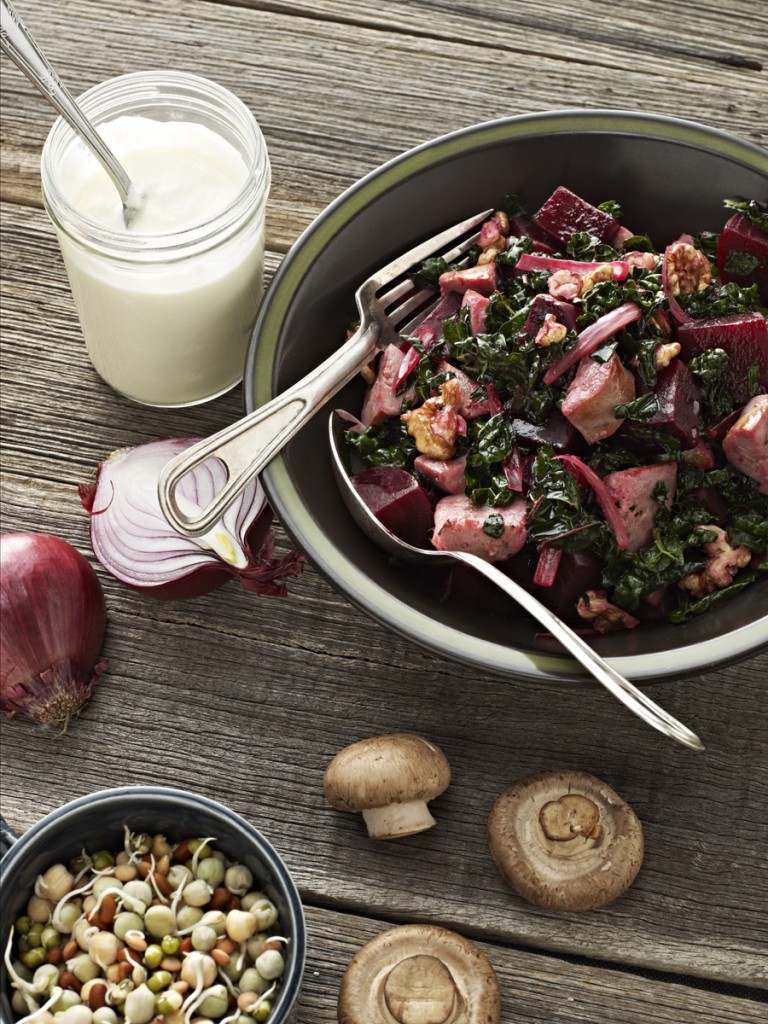
Photo by Marija Ivkovic

Now. I’m not suggesting eating out of bins. But I am suggesting thinking before you chuck stuff in bins. If you care about food in any way, then every bit of care should be taken to not waste any of it…and to get creative with the “whole” food. Recycling and composting isn’t enough; cutting waste in the first place is where we should be heading. To get things started, I’m going to get leafy with it…

Beet leaves:

These things possess most of the properties of most greens – whether it be spinach, silverbeet or kale. And, no doubt many of the properties of beetroots themselves. Dr. Bowden, author of  The 150 Healthiest Foods on Earth, lists beetroots as one of the top foods you should be eating. Think of beets as red spinach, he says, because they are a rich source of folate as well as natural red pigments that may be cancer fighters.

What do they taste like? Much like spinach, but more like kale in texture.

How to cook them? As you would spinach etc. I don’t advise eating raw. I add them to soups, casseroles and they’re great with eggs (see the frittata recipe below). Or you can try this one:

Sausage and Beetroot Hash

  • 1 good quality sausage (I like a pork sausage with fennel seeds)
  • 1 small beetroot, partially precooked, cut into 2cm cubes, or  wedges*
  • red onion or a few green shallots

    Read more

I Love food, hate waste: how to eat your scraps

OK. Brace yourself. I’m fired up. I’m an ambassador for the International Love Food Hate Waste program and I’m going to be doing a series of posts that I truly hope will get as many of you as possible thinking about how much respect you have for food and the work and life and carbon miles and water and…. you get the drift… that goes into having it in our lives. I’ll say it not for the last time: wasting food is inexcusable. Period. Check out these facts:

2211 2main I Love food, hate waste: how to eat your scraps
Image via www.veryshortlist.com

In Australia alone, we buy $7.8 billion per year of food we don’t use.

Households are throwing more than $1000 – or 585kg – worth of food into the garbage each year.

In America, getting food to our tables eats up 10 percent of the total energy budget, uses 50 percent of U.S. land, and swallows 80 percent of freshwater consumed in the United States. Yet, 40 percent of food in the United States today goes uneaten.

And then this: discarded food rotting in landfill gives off methane 25 times more potent than the carbon pollution that comes out of your car exhaust.

It’s a disgrace. There’s no excuse for it. None. I’m not going to get all “think about the starving kids in Africa” on you. Because the issue is more fundamental. It’s just plain wrong to waste. Anything. And if you care about food in any way, then I personally and very passionately feel you have to give a shit about this.

Anyone who knows me knows the extent I go to to not waste food. I won’t leave the house to travel interstate without using up every last scrap. I juice things, soup things. My freezer is full of par-cooked vegetables. I’ll go to friends’ houses and cook their scraps or about-to-turn vegetables for them.

You can catch up on the clever ways I go about not wasting food here and here.

The European Parliament has resolved to reduce food waste by 50 percent by 2020. The Love Food Hate Waste program

Read more

Why your uncertainty is a good thing

A while back I read this interesting post on Psychology Today about embracing one’s uncertainness. Owning it and not running from it. I’m uncertain. I berate myself for it (uncertain people are often self-flagellating, too). I liked the points raised.

18harmony Why your uncertainty is a good thing
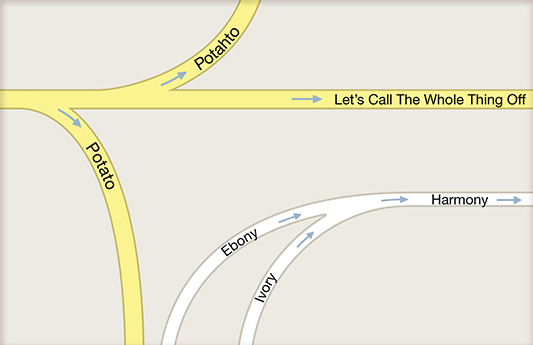
Image by Christoph Niemann

The article highlights that the uncertain among us expend a fair bit of energy unable to get a point across, swayed by the (bullying) certain folk among us, or distracted by the anxiety that comes with being uncertain. But there’s an upside: study your doubt. Get to know the patterns. See what’s going on when uncertainty strikes. Thus, writes the author…

“With practice you can become familiar enough with self-doubt and anxiety that you hold them nimbly and un-distractedly…

A benefit is that, when your doubt is exposed in debate it’s no surprise to you.  You don’t flinch with a sudden surge of anxiety about your anxiety. You can stick with the topic under debate, persisting in what you’re insisting on.

If (the certain people) call attention to your doubt, you simply say or imply something like, “Of course I have doubts about my position, as any respectable thinker would.  They fit the standard mold and for you I’ll list them (do this briskly but calmly).  Now that said, I still place my full weight behind my position.

Read more

which fats should i be eating?

Heaps of you have asked me to do a post that spells out what fats to eat, and when and how. So here we go.

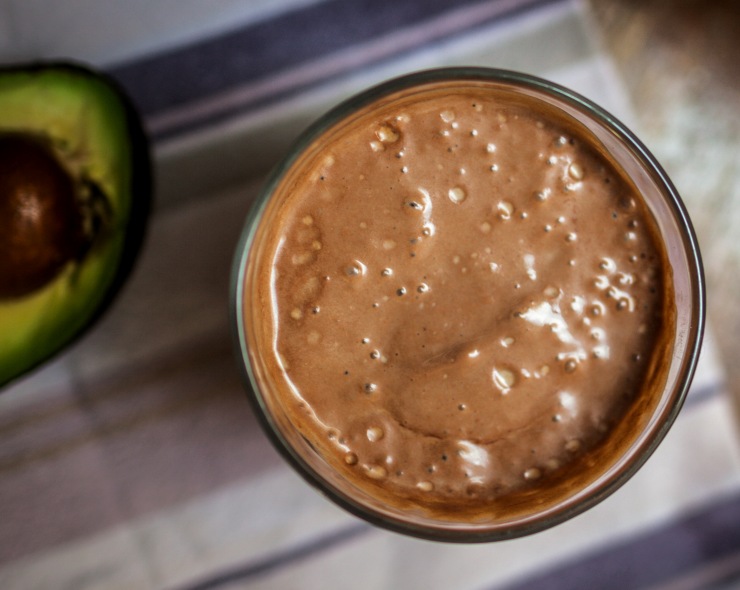
HOTCHOC 059 which fats should i be eating?
coconut butter: a recipe from my I Quit Sugar Cookbook

First, let’s acknowledge the information out there is conflicted. More and more the scientists and chefs and wellness nuts are agreeing: the fats we’ve been told to eat for the past 50 years – the poly-unsaturated, so-called “vegetable” ones – are, in fact, the worst stuff we can put in our bodies. And the fats we’ve been told to never touch – the saturated ones – are actually the healthiest, safest and, in fact, are the least “fattening” (if you’re not eating a sugar and carb-heavy diet while also eating fat).

Learn more by reading my post on how the science now shows saturated fat is good for us.

I’ve been following the debates for a bit, weighing up what’s right. Here are some of the issues explained and a rundown on how I eat my fat:

some science to get started

Whether a fat is safe to eat is based on two things:

  1. its smoke point (higher the better)

    Read more

five spiritual books to read this weekend

I was asked this recently and promised to share. I’ll keep it simple and to the point…just a few reads that have made a difference to me and might to you, too. Feel free to add to the list below…

Picture 281 five spiritual books to read this weekend
image via pinterest

A Path with Heart by Jack Kornfield

A wonderful manual for deep meditation practice. His “choose the one seat” lesson sticks with me (choose one style of meditation or practice and just stick with it…because the style doesn’t matter, it’s the doing it part that does).

Letters to a Young Poet  by Rainer Maria Rilke

Sublime…the kind of thing that Lada Gaga gets tattooed on her arm. Insights like this: “I hold this to be the highest task for a bond between two people: that each protects the solitude of the other.” Word.

The Power of Now by Eckhart Tolle

Somehow this guy just nails the whole “oneness” concept better than anyone else. If you’re after a starting point or a refresher, this is your book. I refer back to it from time to time, opening it to where it naturally falls and reading a page. I finally got the beauty of the “present moment” with this exercise. He instructs you to ask yourself “what’s the issue right now?”. Not tomorrow, not in 30 minutes, not in 1 minute, not in one second from now. What’s the issue right now. Of

Read more

another (surprising) reason to exercise

I don’t exercise to get fit or lose weight. I do it to get clear and clean in the head. And I do it every day, because I want to be clear and clean every day. As it’s a simple, do-able goal with an immediate outcome (I feel clearer and cleaner instantly, but I don’t lose weight from exercise for months, if at all), I’m rewarded for my efforts and incentivised to keep going. And going.

8e10f5c0f9a011e1ba4022000a1e8932 7 another (surprising) reason to exercise
Me mountain biking in Provence…one of the most creative things a girl can do

But another reason to exercise is for the mental agility it imbues, which, in turn, aids creativity.  I read this interview with Murakami in The Paris Review recently that touches on this. I thought I’d share. As with everything uttered by Haruki Murakami, it’s elegant and clear and clean:

” When I’m in writing mode for a novel, I get up at 4:00 a.m. and work for five to six hours. In the afternoon, I run for ten kilometers or swim for fifteen hundred meters (or do both), then I read a bit, and listen to some music. I go to bed at 9:00 p.m. I keep to this routine every day without variation. The repetition itself becomes the important thing; it’s a form of mesmerism. I mesmerize myself to reach a deeper state of mind. But to hold to such repetition for so long–six months to a year–requires a good amount of mental and physical strength. In that sense, writing a long novel is like survival training. Physical strength is as necessary as artistic sensitivity.

I totally agree with the repetition bit. And the every day bit. And the bit about physical strength being important to creative success. I draw on the physical depths I’ve gone to over the years to achieve all kinds of things. My four-week

Read more

Alain Ducasse’s provencal vegetables

A culinary highlight during my time in France recently: eating at Alain Ducasse’s La Bastide de Moustiers restaurant in Moustiers Saint Marie in Provence…not far from the Gorge du Verdon (a mouthful!). I was in the area hiking and mountainbiking with my brother and it felt just plain wrong not to eat there. I was reminded that it was here in the region while scouting MrandMrsSmith …they look after the hotel and restaurant on their site.

15757004fc0d11e1a2f822000a1d012f 7 Alain Ducasse's provencal vegetables
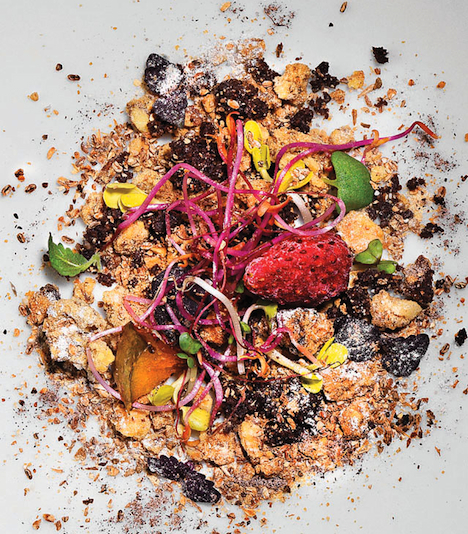
Elegance on a plate

Let it be said: the French know how to plant food on a plate perfectly. Somehow it doesn’t come out all pretentious and silly. It’s all for a reason. Just enough fussiness to show a carrot the respect it deserves. Just enough jus or smear or garnish to make a turnip sing. There is no superfluous flourishes, no excess, always just enough and always respect for the process of eating.

This is why the French don’t get fat: they’re not at war with food. They’re at ease with it.

I admire the way the French eat. I really do. But back to Bastides….

I ate nine courses, sitting on a terrace overlooking lavender fields and olive groves with that Provencal light that sends Peter Mayle-ites into spins. I’ll share more pictures of the various courses below. But first to course four: a plate of vegetables. Yes. A plate of vegetables. All picked that morning. Supremely fresh and sweet. They were served before the meat (pork) arrived. Which is a nice idea. Too often vegetables are seen as fodder, to be doused in sauce, mopped up

Read more