This is an ad for a global sneaker brand, I know. And it’s been, no doubt, developed by a team of brand psychologists who conspire to manipulate the human mind for consumerist outcome.
But.
Gosh, it’s good and touching.
We need to hear from other people – especially people we regard as successful – about how they failed more than they succeeded. For two reasons.
So we know success isn’t something magical and based on luck. That it’s about hard work. And we can all do hard work, right?
And also to remind us that we ONLY succeed by going DOWN into failure. Going down means we then build up “success strength” in the grapple back out. Going down buys us the time to know what we’re doing. Going down cements what we really want (because you have to have something to aim for when you grapple back out). Going down means when we succeed, we’re the real deal, not just a fluke.
To really get the message, you need to see this, too:
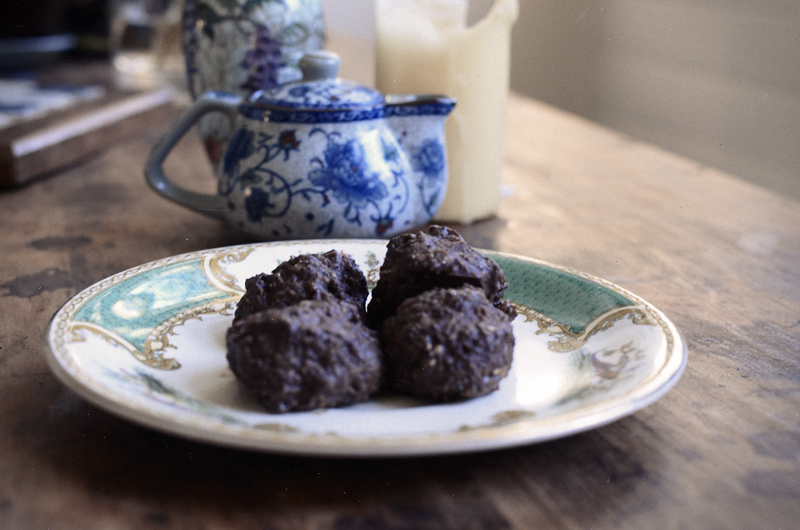
Over the weekend, my partner in “Sunday mornings on the deck eating eggs + reading the papers” crime Lizzie and I made nutballs. This is them…
Three things you need to know:
1. These balls of goodness are so healthy and anti-oxidising that you can eat them for breakfast. And just to test the theory, I did so this morning.
2. They are not addictive and you won’t eat the whole lot in one sitting. How so?
They contain ZERO sugar
They are rich in good fats that fill you up pleasantly and fast. Seriously, no desperate hankerings afterwards.
3. Lizzie and I are the two most impatient women on the planet: we whizzed these together in three minutes, including the taking of pretty pictures.
The recipe is derived from a nutball recipe Nora Gedagaudas sent to me. We kind of modified it, throwing in stuff we liked. You seriously don’t have to worry about exact quantities. You can’t stuff this recipe up! And don’t be afraid of the butter and coconut oil. It’s goooooood for you!
my sugarfree nutballs
half a jar of almond spread
250g or so of organic nuts. We used almonds, brazil nuts and walnuts for their hormonally healthful properties. We tried using a stab-mixer, but it turned them into a powder, so promptly switched to a large food processor).
1/2 cup of raw cacoa powder (to taste)
2 big handfuls of shredded coconut
1/2 a stick of organic salted unadulterated butter. Or use the whole packet (200-250g) if you don’t have coconut oil.
This week in Sunday Life I remove comments from my blog. Just for a bit.
Illo by Geoff McFetridge
When I’m feeling a tad on the smug side of my life situation, I find a little visit to the comments section of my blog sets me straight. In the main, comments on my blog are helpful sharings of tips and links. But every now and then a snarky interloper pipes up, like a foul air bubble in the lower intestine, to pull apart the most banal detritus of my existence.
Such as whether I Photoshop out a gap in my teeth.
Or how many times I say “um” in a podcast.
I find it a practice in mindful ego control, mostly. I observe the snarkiness bubble to the surface. Smile. And accept that I put myself out on a limb by having a public blog, ergo I must accept some flack. And then I let the stinky snark float on past, ignoring the urge to pop it with well-crafted comeback. It’s a bit like handling a toddler: acknowledge good behaviour, ignore bad behaviour. With time, I’ve developed a lovely Teflon calm from the process.
I’m lucky, though. I’ve only had to remove two comments in almost two-and-half years of running my blog. But this is not the norm. Monitoring comments has become a laborious chore for many (some bloggers I know remove 40 per cent of contributions daily). So much so, a growing number of the big blogging names have dropped their comments sections altogether, despite the commercial reality that comments are traffic drivers, which, in turn, are monetisation drivers.
This is no trifle issue. It’s dictating news agendas, hurting people in humiliating and irreversible ways and driving some to suicide. Nasty comments can be hate-bombed into the interweb by cowards who hide behind pseudonyms and there’s nothing that can be done to discipline or control them. Unlike a hand-posted letter to the editor of yore, these comments are not carefully and mindfully prepared. And social media commentators argue commenting contradicts the original notion of the social media “conversation”. They’re more akin to an impulsive heckle at a footy match – unaccountable and mostly about me too-ism. As a result, the Australian Press Council last month called for a discussion on online reader comments as part of their broader enquiry into media standards.
Apropos of something, I love the Swedes. They’re so often the first to buck the system, mostly in the nude and incorporating a community garden. Last month they led the way once more when three of the nation’s four newspapers banned anonymous online comments.
All of which has got me thinking: should I take a stand and drop comments on my blog?
I posted my interview with Nora Gedgaudas last week that detailed the whole paleo diet thing. I’m two weeks in and am noticing amazing differences – which I’ll report back on.
Photo by Santiago Design
Anyway, I know a lot of readers on this site have an auto-immune disease of some sort. Nora very kindly talked me through her tips for anyone suffering AI, specifically hashimotos. It all fits. I’ve been told for years the paleo diet is ideal for AI issues. I thought you AI types out there would find it useful (apologies to everyone else…and apologies for my rambly chat…I was having a very “thyroidy” day that day…and you know how that goes…)
Nora then went the extra mile and emailed me to confirm many of her complex points (your head spinning much from listening to the above?). I love that she uses the word “modulation” as the approach that needs to be taken.
It’s so very much about modulation.
The primary issue at hand is IMMUNE function (specifically, a need for immune modulation).
Most if not nearly all cases of autoimmune thyroid are profoundly tied to gluten sensitivity and/or celiac disease (either as an initiating or complicating issue). Avoiding ALL gluten and whatever cross-reactive compounds you have a sensitivity to should be 100%, immediate and permanent. Nearly all available testing for gluten sensitivity currently is quite unreliable…so if you think you aren’t gluten sensitive you may want to seriously reconsider revisiting this though more in depth testing. If it were me, I’d just assume an issue with gluten and avoid it like the plague.
Healing your gut is hugely important in this. It will be impossible, btw, without generating healthy glutathione levels.
Shoot for between 80-100 ng/mL 25 OHD (vitamin D) in blood tests.
Oh, you know what. Deep breath. This… Have you ever done something that’s terrified you to the core? That you have to dive into with no map, no instructions, nothing to hold onto? Instead you must freefall with no guarantee of where – and if – you’re going to land? Something that you know will … Read more
Perhaps you’re a blogger with the same wellness outlook as me? Perhaps you’ve read my ebook? Perhaps you’re fired up about recommending it to your readers? Yes? Well, how about this…If you liked the book, and you want to share your thoughts on it with your readers, I’ll help you make some money for your … Read more
I believe I’ve found the very latest first-world lament. “I’m so sick of trying to get enough ‘me time’,” my friend Sal shared over the phone during the week. “I think it’s easier just to be overcommitted and be done with it. Know what I mean?”
I would’ve coughed up my latte. Or my chardonnay. But I was too busy eating my organic, grass-fed granola.
Actually, I’ve been waiting for someone to pipe up along these lines for a while. The pursuit of life balance has become yet another thing most of us are crap at, which means it’s yet another thing we feel compelled to master, which means it’s yet another thing to add to our to-do list.
Life balance is elusive. Just how do you ensure the right balls are in the air in the right ratios? For every new commitment you take on, do you allocate the same amount of time for sitting in a bath or Cooking a Quality Meal or doing a Meaningful Craft Project with your kid? If a passion, work project or a sick partner suddenly require more of your time, do you have to put on the breaks? “Woah world! No can do – I’m behind on my yoga class quotient!”
Scoff not. A friend told me they were stood up recently by someone citing they were “owed some hang time”. Hang time. Me time. I get it. But, seriously, the idea of “owing” it is as dispiriting as Sunday night ironing.
It’s a reality, of course, that most of us need more hang time. Life is well out of whack. But is fighting the tide, constantly trying to redress things – tit-for-tat-ish – the solution?
How about I pause then to cite the very latest research that answers such a hypothetical.
I can get obsessed by words. I’ll say them over and over in my head. Or they take on a colour or a smell. Mostly they take on a shape. I was obsessed with “common” when I was a kid. I wrote it over and over in books. Not because of how it sounded (or Lord forbid, what it meant) but because it looked like a caterpillar.
I get Gary And Greg mixed up always, because visually they’re the same shape. See what I mean?
But I have three favourite words. I adore them for their slighly onomatopoetic value and because they “suggest” a mood, a feel, a vibe, rather than spell something out aggressively. So that when you say the word, you just “get” it, even if you can’t point to it. Not surprisingly, perhaps, there’s no English equivalent for any of them.
1. Haimish
A Yiddish word that suggests warmth, domesticity and unpretentious conviviality. A cosy, tatty, daggy bar where the hot chocolate is served in 1970s pottery mugs is haimish. A night in with girlfriends under a doona eating stew repeats is haimish. Going home to mum and dad’s and playing boggle while drinking sherry is haimish. David Brookes at NYT wrote a wonderful ode to the word recently, extrapolating the idea out and suggesting we need to seek more of it in this individualistic culture.
2. Hygge
This one is a danish word pronounced “hoo-gah” and it kind of means “cosiness”, but as a Dane will tell you…it means so much more. It defines the core of Danishness as “chic” defines the French. One definition I’ve found says it’s the art of creating intimacy. So it’s an act as well as a feel – a verb and an adjective. Hygge is also something you consciously strive for…it’s about connecting in a cosy, elegant, unfussy way. It’s about weaving friendship and intimacy with ease. Let’s get hygge with it!!!
I often get asked what books I’m reading. I’m really bad at answering definitely (on most things). In part because my memory is shocking. But also because everything is always “for now”.
photo by edina csoboth
So, here are five reads I’ve experienced recently that touched me because the author truly went deep into their search or their fear or their desire to share and connect. And in turn took me to my own version of this place. Not in a bash-over-the-head way. But just through the process. You might like them, too.
1. Your Voice in My Head by Emma Forrest.
A quirky memoir of an eccentric as she grapples with managing her weirdness and various breakdowns via what is almost an ode to her shrink. It’s a tender, sad and real read. It could be accused of being self-indulgent, in a Prozac Nation way. But it dodges such a call with the bravery and rawness of her writing. It’s unapologetic. And this frees it from contrivance. And freed me to dig down deep with her and to feel the freedom of it all. PS a big part of the book is her battle to recover from one particular ex…who is clearly Colin Farrell. Buy it here.
2. This is Not the Story You Think It Is by Laura Munson.
This book started as a Modern Love column in The New York Times in which Laura details how she sticks by her husband when he announces he’s leaving the marriage. She refuses to buy his story. Not because she’s a martyr or damaged or desperate. Instead it’s because she chooses not to do pain. This means sticking by the man she’s always loved. It’s a fascinating and very pragmatic approach to love and I like it. As real as it comes. I interviewed Laura and you can read about it here. Buy the book here.
On Friday I had the indescribable joy of chatting to Nora Gedgaudas on Skype. Nora wrote the paleo living bible Primal Body, Primal Mind and is a gem of a woman.
photo via The Alkaline Sisters
In a nutshell, the premise of her thinking is this:
* our genealogy hasn’t changed since Paleolithic times when we ate fat, protein and low-starch veggies.
* our diet has changed to a high carb/sugar/starch diet, with the introduction of the agricultural period 10,000 years ago, which our bodies have not been able to adjust to…which makes us sick and tired.
Ergo:
We need to eat MORE FAT and ELIMINATE CARBS for optimal health and longevity.
Perhaps the most home-hitting point she makes is this:
Fat doesn’t make us fat, fat eaten with carbs does
and:
We aren’t what we eat, we’re how we metabolise what we eat
If you’re interested in all this, her book is seriously the go-to bible. I went crazy with my highlighter and post-it reading it last week. And for auto-immune/hashimoto sufferers…it almost caters directly to our conditions (Nora’s family all have hashimotos).
The great news is: Nora’s also out here in Australia in November speaking at universities in Sydney, Armidale and the Gold Coast. I’ll be at the Goldie to see her speak. It will be rad.
But in the meantime…our chat:
[display_podcast]
Some of you asked some questions via twitter on key points of the paleo diet. I thought I’d spell things out a little, because they’re themes that I’ve touched on a lot on this blog. My sugar quitting philosophy is similar, ditto my exercise approach.
But aren’t grains needed by our bodies?
It would appear not. They contain no essential nutrients we can’t get from elsewhere in more effective ways. They’ve traditionally been eaten when fat and protein haven’t been around (and, thus, signal to the body there’s a famine going on). Since we have the option not to eat them, why would we? Especially given the below…